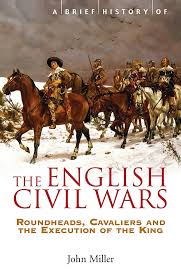
John Miller’s A Brief History of the English Civil Wars is
more than just a concise account of the 1640s; it embodies the revisionist
orthodoxy that has shaped English Civil War history since the late 20th
century. The defining feature of revisionist historiography… is its explicit
rejection of the Marxist interpretation that the English Civil War constituted
a bourgeois revolution.”
Miller’s work challenges not only Christopher Hill and the
Marxist Historians’ Group but also the idea that history progresses through
class struggle and revolutionary change.
Miller and the revisionist turn
The revisionist school, including Conrad Russell, John
Morrill, Kevin Sharpe, and Miller, emerged specifically to challenge the
Marxist claim that the English Civil War was a bourgeois revolution. Hill’s
works, The English Revolution 1640 and The Century of Revolution, maintained
that the conflict symbolised the political ascendancy of a rising bourgeoisie
over a feudal-absolutist regime, paving the way for capitalist growth.
Revisionists challenged this framework by arguing that there
is no measurable "rising bourgeoisie," as men from all social classes
participated on both sides of the conflict. They claimed that religion and
short-term political errors, rather than class struggle, fuelled the events.
This perspective views the episode as a largely contingent, preventable tragedy
resulting from Charles I’s political mistakes and brief religious divisions. In
this view, Charles I’s execution is seen as an unfortunate accident rather than
the decisive overthrow of a feudal system.
Miller’s book illustrates this change by providing a vivid
narrative and personality-focused explanations instead of a deep analysis of
social forces at work. It richly describes court intrigues, religious
factionalism, and military campaigns, but it does not explore the core
contradictions of a society shifting from feudal to capitalist structures. This
approach is typical of the revisionist tendency to shift from structural
analysis toward emphasising contingency and “high politics.”
Hill and the concept of bourgeois revolution
The Marxist interpretation by
Hill and British Marxist historians never relied on a simple, mechanically
deterministic model. Hill recognised that a “chemically pure
revolution"—where all members of a class align perfectly—was unrealistic.
As Ann Talbot notes, "Hill... had read enough Marx and Lenin to understand
that one could not expect a chemically pure revolution." The focus is not
on sociological neatness but on the revolution's actual function: it inherently
advanced bourgeois interests by dismantling the feudal-absolutist state,
executing the king, abolishing feudal tenures, and creating the political
environment necessary for capitalist growth. Hill’s works—Intellectual Origins
of the English Revolution, Economic Problems of the Church, and The Century of
Revolution—connect ideological and religious conflicts to changes in property,
commerce, and class dynamics.
What Miller’s approach obscures
Revisionism cannot account for why people at the time viewed
the 1640s as a period of unprecedented upheaval. As censorship eased, groups
like the Levellers, Diggers, Ranters, and Fifth Monarchists gained visibility
in print, advocating demands that went beyond merely restoring an “ancient
constitution”: "They called for levelling social classes, ending private
property, and establishing the rule of the saints." These groups
articulated, using religious language, the social tensions brought about by the
collapse of feudal relations and the rise of new forms of property and
authority. Hill’s research considered these voices as evidence of profound
structural change, whereas revisionism tends to dismiss them as marginal,
eccentric, or solely theological.
The political function of revisionism
Miller’s focus on narrative and personality shifts away from
exploring why civil war became possible and, eventually, inevitable. This
creates a depoliticised history marked by vivid descriptions but lacking causal
explanation, contingency without necessity, and tragedy without revolutionary
context. The rise of revisionism can be traced to the period after the USSR's
dissolution and the ideological campaigns against Marxism: "The
revisionist school gained ascendancy in the period following the dissolution of
the USSR, when the bourgeoisie internationally sought to bury the concept of
revolution itself.”
This is essential. Denying that the English Civil War was a
bourgeois revolution is tantamount to denying that capitalism arose through
revolutionary violence. If capitalism is seen as the outcome of slow, peaceful
development, then viewing it as susceptible to overthrow via revolutionary
struggle is dismissed from the start. Ann Talbot’s WSWS review of Hill clearly
links this political viewpoint: “The prevailing academic orthodoxy is that
there was no bourgeois revolution because there was no rising bourgeoisie and
that people from all social classes can be found on either side of the struggle
... The whole unpleasant episode could have been avoided if only Charles II had
been a little wiser.”
Contemporary significance
Many modern historians, like Simon Schama, often see
themselves as "born-again Whigs,” offering a polished account of
constitutional development and national cohesion. This view echoes the
tradition that Hill aimed to challenge during his work. Instead of introducing
a radically new perspective, revisionism mainly revisits earlier, pre-Marxist
Whig interpretations of history, now presented with an air of empirical
scepticism.
Today, whether the English Civil War was a bourgeois
revolution remains a relevant issue for the working class. “A class that cannot
face its own revolutionary origins cannot face the revolutionary future that
awaits it." The bourgeoisie once celebrated its revolutionary history;
now, its denial of that past shows its evolution into a fully
counter-revolutionary class. To see the English Revolution as a true
revolution—and to glean lessons for the fight against capitalism—is the role of
Marxist history and a politically organised, conscious working class.
Miller’s A Brief History of the English Civil Wars, by
aligning with revisionist orthodoxy, engages in the ideological act of masking
that revolutionary legacy. In contrast, your critique aligns with the
traditions of Hill and Trotsky, emphasising that the English Civil War was a
pivotal event marking the shift from feudalism to capitalism, and that its
significance can only be understood from the perspective of class struggle.
Bibliography
Primary and historiographical works
- Christopher
Hill, The English Revolution 1640 (London: Lawrence &
Wishart, 1940).
- Christopher
Hill, The Century of Revolution 1603–1714 (London: Nelson,
1961).
- Christopher
Hill, Intellectual Origins of the English Revolution (Oxford:
Clarendon Press, 1965).
- Christopher
Hill, Economic Problems of the Church in the Sixteenth Century
(London: Oxford University Press, 1956).
- Leon
Trotsky, Where Is Britain Going? (London: New Park
Publications, 1973; originally 1925).
- John
Miller, A Brief History of the English Civil Wars (London.
- Conrad
Russell, The Causes of the English Civil War (Oxford: Clarendon
Press, 1990).
- John
Morrill, “The Religious Context of the English Civil War,” like the
English Revolution, ed. Morrill (London: Longman, 1993).
- Kevin
Sharpe, The Personal Rule of Charles I (New Haven: Yale
University Press, 1992).
On Marxist and revisionist historiography
- Alastair
MacLachlan, The Rise and Fall of Revolutionary England: An Essay in
the Fabrication of Seventeenth‑Century History (New York: St. Martin’s
Press, 1996).
- Harvey
J. Kaye, The British Marxist Historians (Cambridge: Polity
Press, 1984).
WSWS and contemporary commentary
- Ann
Talbot, “Christopher Hill and the English Revolution,” World
Socialist Web Site (WSWS).
- Simon
Schama, various works and interviews describing himself as a “born‑again
Whig” in relation to English history.

No comments:
Post a Comment