Sunday, 4 July 2021

Heaven: A Novel by Mieko Kawakami-Translator: Sam Bett and David Boyd-New York. Europa Editions. 2021. 192 pages.

"Whom do I hate most among the rabble of today? The socialist rabble, the chandala apostles, who undermine the instinct, the pleasure, the worker's sense of satisfaction with his small existence—who make him envious, who teach him revenge. The  source of wrong is never unequal rights but the claim of "equal" rights"—Nietzsche's The Anti-Christ, 1888

"I was always quite a philosophical child, asking odd questions and in a hurry to grow up". Mieko Kawakami

"'Progress' is a modern idea, which is to say it is a false idea."—Nietzsche's The Anti-Christ, 1888

Mieko Kawakami latest novel, excellently translated by Sam Bett and David Boyd, is a brutal examination of adolescence in Japanese society. The book is drawn from her childhood in Osaka, Japan. By all accounts, it was a pretty bad experience. Her father was never home. Forced into being the main breadwinner at a tender age to support her family gave her the ability to write this "novel of ideas"  ". As Kawakami says, "I was always quite a philosophical child, asking odd questions and in a hurry to grow up".

Kawakami started to write at a very early age. She explains that "I try to write from the child's perspective—how they see the world. Coming to the realisation you are alive is such a shock. One day, we are thrown into life without warning."

In an interview with The Japan Times, Kawakami says, "I wanted to create a story that examines how religion, ethics and friendship influence human relationships," she says. "Do we live our lives under the guidance of something bigger, like spiritual or ethical beliefs, or do we live as individuals?".[1]

As Elaine Margolin perceptively writes, "Kawakami is captivated by that precious time of life when one is on the cusp of adulthood but still really a child. The author's ability to mimic the rhythmic disturbances of a teenage mind is mesmerising; she is a master of the interior voice. She instinctively grasps how one can feel silly and light one moment and be in the throes of anguish the next. In one of her earlier novels, Ms Ice Sandwich, she describes a lonely boy whose family is in disarray, finding solace by visiting a supermarket worker each day who kindly gives him an egg sandwich".[2]

The book's theme of childhood bullying is a universal one. " Kawakami explains that the nature of bullying has changed. "In the old days, there were just two places for relationships — home or school — but now, with social media, there is nowhere to hide, and the pressure is constant. Victims of bullying think the whole world knows they are being bullied. It is even crueller today with the way it can be spread."

I still remember my childhood bully. His name was Desmond Kavanagh. His reign of terror did not last too long. Unlike Kawamaki's character, who does not fight back, one person in my school had enough of Kavanagh's bullying and kicked the crap out of him. The bizarre thing is that Kavanagh tried to befriend me on Friends Reunited a few years later.

Novel of Ideas

Heaven has been described as a novel about ideas. Writing a "novel of Ideas" is a complicated business. Kawakami draws heavily on the work of philosophers like Frederich Nietzsche and Kant. A blog that she started to promote her singing career, "Critique of Pure Sadness," displayed an unhealthy fascination with Kant. Her latest book leans heavily on Nietzsche's Thus Spoke Zarathustra. This is a very unfortunate choice, especially for such a young writer. Nietzsche's hostility towards the working class and socialism and his disdain for objective truth made him a favourite writer of the Nazi movement.

As Stefan Steinberg states, "Apologists for Nietzsche seek to distance him from the policy and activities of the Nazis. But is Nietzsche's position here so remote from Adolph Hitler's entreaty, in an internal NSDAP memo of 1922, for the: "most uncompromising and brutal determination to destroy and liquidate Marxism"? Adolph Hitler was certainly no philosopher, just as Nietzsche was not merely a political ideologue. But who can reasonably doubt that the former had little difficulty in seamlessly incorporating the latter's thoroughly backwards-looking programme of biological racism, hatred of socialism and the concept of social equality—together with his advocacy of militarism and war—into the eclectic baggage of ideas which constituted the programme of National Socialism"?.[3]

The strength of the novel is Kawamaki's examination of ideas as a way of writing a novel. As Merve Emre writes, "dreamlike expression of their fledgling ideas has an artistic value that flies in the face of critics like Northrop Frye, who believed that an "interest in ideas and theoretical statements is alien to the genius of the novel proper, where the technical problem is to dissolve all theory into personal relationships." But "Heaven" also models a rigorous and elegant process of inquiry that can transcend its pared-down fictional world. It agitates against the enduring idea that the best novels concern themselves with the singular minds and manners of people, offering no resources for the political and moral demands of "real life." The narrator's persecutor Ninomiya energetically parrots this argument".[4]

Kawakami, ability to write from a child's perspective is astonishing at times and avoids what one writer says are "puffed-up platitudes about the inherent cruelty and sympathy of children".

If I am generous, I would say that Kawakami also avoids Nietzsche's social and political pessimism and presents the world of children accurately. One major criticism is that, unlike many great Japanese writers, such as Yukio Mishima and Kazuo Ishiguro, she does not place her characters in this book in a social or political context. The reader would not know that while "Heaven" takes place in Japan, bullying is rife in Japanese society so much that classroom harassment forced a government to bring in national legislation because of a growing number of student suicides.

To conclude, Kawakami's work is well worth reading. Her fiction deals with the problems of everyday life for working-class people in Japan. That is one of the reasons behind her popularity. She examines critical social issues that permeate Japanese society. These include broken families, absent fathers and children struggling to find themselves in a increasingly cruel world. It is hoped that she does not spend too much time absorbing Nietzsche's works and instead let herself be influenced by some more healthy writers such as Thomas Mann and Hermann Hesse. She has a bright future, and I look forward to her next novel.

 About the Author

Mieko Kawakami is the author of the novel Breasts and Eggs, a New York Times Notable Book of the Year and one of TIME's Best 10 Books of 2020. She was born in Osaka. Kawakami made her writing debut as a poet in 2006 and published her first novella, My Ego, My Teeth, and the World, in 2007. Her writing is deeply imbued with poetic qualities. Her work concentrates on the plight of women in Japanese society. Her works have been translated into many languages and are available all over the world. She has received numerous prestigious literary awards in Japan for her work, including the Akutagawa Prize, the Tanizaki Prize, and the Murasaki Shikibu Prize.


[1] https://www.japantimes.co.jp/culture/2021/05/27/books/heaven-mieko-kawakami/

[2]https://www.worldliteraturetoday.org/2021/spring/heaven-novel-mieko-kawakami

[3] https://www.wsws.org/en/articles/2000/10/niet-o21.html

[4] https://www.newyorker.com/magazine/2021/06/07/a-japanese-novelists-tale-of-bullying-and-nietzsche

Tuesday, 22 June 2021

Review: The 1619 Project: A Critique by Phillip W. Magness- Paperback 148 pages – April 2020-American Institute for Economic Research.


"History is not a morality tale. The efforts to discredit the Revolution by focusing on the alleged hypocrisy of Jefferson and other founders contribute nothing to an understanding of history. The American Revolution cannot be understood as the sum of the subjective intentions and moral limitations of those who led it. The world-historical significance of the Revolution is best understood through an examination of its objective causes and consequences".[1]

"That on the first day of January, in the year of our Lord one thousand eight hundred and sixty-three, all persons held as slaves within any State or designated part of a State, the people whereof shall then be in rebellion against the United States, shall be then, thenceforward, and forever free; and the Executive Government of the United States, including the military and naval authority thereof, will recognize and maintain the freedom of such persons, and will do no act or acts to repress such persons, or any of them, in any efforts they may make for their actual freedom.[2]

Emancipation Declaration

Carry On Cleo is a 1964 British Comedy. In one scene, Julius Caeser, played by Kenneth Williams, is about to be assassinated by his bodyguards. Caesar sends out his bodyguard Hengist Pod played by Kenneth Connor, to save his life. Pod is a first-class coward. Hod faces the assassins only to find that someone else has slain them all. Hod goes back to Caesar and claims the credit.[3]

Reading Phillip W. Magness's book reminds me of this scene because he seems to take too much credit for something he does not entirely deserve. His downplaying of the lead political and historical role played by the World Socialist Website in exposing the lies and falsification of the 1619 project is especially troubling.[4] In 120 pages, he makes just one mention.

Despite being a critique of the 1619 project, Magness's short book gives this wretched piece of journalism and history far too much credit. He writes, "the newspaper's initiative conveyed a serious attempt to engage the public in an intellectual exchange about the history of slavery in the United States and its lingering harms to our social fabric".[5]

Magness, it seems, had no problem with the 1619 project until a number of the essays contained in the project assert that the origins of modern-day American capitalism stemmed largely from slavery. While making some correct historical points, Magness is not concerned with the preposterous claim that the American Revolution and Civil war were fought to defend slavery but is concerned with the projects "heavily anticapitalist political perspective".Magness critique of the project is not from the left but the right.

One of the more disturbing aspects of Magness's book is his agreement with the 1619' s project attack on Abraham Lincoln. He writes that he "has devoted a significant amount of scholarly work to Lincoln's presidency. I weighed in on the arguments as presented, showing that the 1619 Project's assessment was in closer line with historical evidence that these critics neglected to consider. The essays are presented herein, and they place me in the curious position of being one of the only 1619 Project critics to also come to its defence on one of the major points of contention.[6]

The 1619 Project's and Magness's attack on Abraham Lincoln is not only wrong but reprehensible. The 1619 Project's vendetta against Lincoln has been described as his second assassination. Lincoln's attitude towards slavery was complex and contradictory. To label him a racist is simplistic and false. As David North points out, "Abraham Lincoln was an extraordinarily complex man, whose life and politics reflected the contradictions of his time. He could not, as he once stated, "escape history." Determined to save the Union, he was driven by the logic of the bloody civil war to resort to revolutionary measures. In the course of the brutal struggle, Lincoln gave expression to the revolutionary-democratic aspirations that inspired hundreds of thousands of Americans to fight and sacrifice their lives for a "new birth of freedom."[7]

In another sleight of hand, Magness attempts to equate the 1619's project of the racialization of history with all what he calls "far-left groups. He states," Broadly speaking, the political discourse around race, which comes from a very far-left perspective, has an unfortunate effect of crowding out other forms of anti-discriminatory thinking, including the individualist form. The notion of individual rights and the dignity of the human person. The notion that people should not face persecution or discrimination based on their skin colour, based on their religion, based on their ethnicity. These are all stories rooted in the rights and liberties of an individual".

In reality, he is talking about the World Socialist Website. This slander needs answering. The reader can make their mind up by reading the book The New York Times' 1619 Project and the Racialist Falsification of History[8]. But  I would add this quote as a rebuttal to Magness's slur. As David North says, the real purveyors of race theory are not the Trotskyists of the World Socialist Website but come from the academia which comes "Under the influence of postmodernism and its offspring, "critical race theory," the doors of American universities have been flung wide open for the propagation of deeply reactionary conceptions. Racial identity has replaced social class and related economic processes as the principal and essential analytic category".

To conclude, Magness book is, on the whole, an accommodation to the right-wing and racialist politics of the 1619 project. While containing some interesting work on the origins of slavery and early capitalism, the serious reader who wants a real critique of the 1619 project should read the book, The New York Times' 1619 Project and the Racialist Falsification of History.


[1] https://www.wsws.org/en/articles/2019/09/06/1619-s06.html

[2] A Transcription by the President of the United States of America:https://www.archives.gov/exhibits/featured-documents/emancipation-proclamation/transcript.html

[3] https://en.wikipedia.org/wiki/Carry_On_Cleo

[4] wsws.org

[5] https://www.aier.org/article/the-1619-project-a-critique/

[6] https://www.capitalismmagazine.com/2020/04/books-the-1619-project-a-critique/

[7] Racial-communalist politics and the second assassination of Abraham Lincoln

Niles Niemuth, David North-https://www.wsws.org/en/articles/2020/06/25/pers-j24.html

[8] The New York Times’ 1619 Project and the Racialist Falsification of History-https://mehring.com/product/the-new-york-times-1619-project-and-the-racialist-falsification-of-history/


Sunday, 13 June 2021

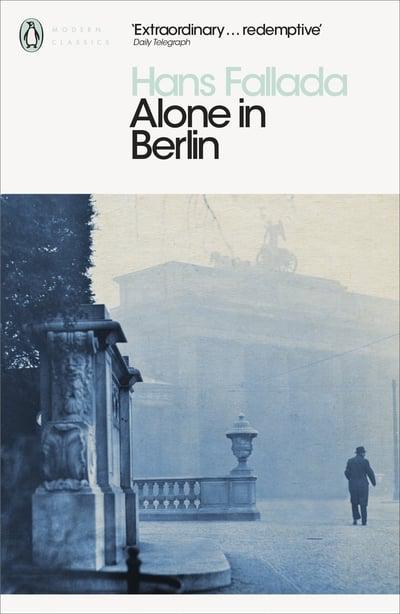
Review: Alone in Berlin-Hans Fallada. Translated by Michael Hoffman. London: Penguin Modern Classics, 2009. RRP £9.99 paperback.

"As it was, we all acted alone, we were caught alone, and every one of us will have to die alone. But that does not mean that we are alone. It doesn't matter if one man fights or ten thousand; if the one man sees he has no option but to fight, then he will fight, whether he has others on his side or not," " 

Otto Quangel

"He who thinks of renouncing "physical" struggle must renounce all struggle, for the spirit does not live without the flesh."

― Leon Trotsky, Fascism: What It Is and How to Fight It

Hans Fallada's excellent novel is set in Berlin of the 1940s. Despite being a fictional account of a German family, the book is based on the life of Otto and Elise Hampel.  Fallada, whose real name was Rudolf Ditzen, was born in 1893 in Greifswald, Germany.

To say he had a strange life would be an understatement. At the tender age of  18,he killed a friend in a duel and, according to James Buchan, spent "much of his career in psychiatric hospitals and drying-out clinics or in prison for thieving and embezzlement to support his morphine habit. In between, he worked on the land, wrote a couple of novels and held down jobs for a period on newspapers. Then, in 1944, he shot at his wife in a quarrel and was confined again to a psychiatric hospital."[1]

After this shocking episode in 1947, Aufbau-Verlag Jeder stirbt fuer sich allein ("Each dies only for himself") was published in Berlin. In many ways, this was a groundbreaking working work in that it was one of the first accounts of resistance to Nazi rule. Unfortunately, tragically Fallada died of a heart attack that same year.

The new English translation of Fallada's novel joins a growing number of recent books that have shown that there was a small but significant opposition to the Nazi regime. Fallada's book counters the lie that there was no opposition to Hitler and that all Germans supported the regime. As Bernd Reinhardt correctly points out, "Fallada's nuanced picture of daily life in the Third Reich shows the falsity of the thesis of Daniel Goldhagen and his supporters, holding that all Germans uniformly supported Hitler and the extermination of the Jews. The latest remake of Alone in Berlin (directed by Swiss actor Vincent Pérez) also rejects a collective guilt thesis. "I wanted to present this omnipresent fear. It was so thick you could cut it with a knife", the director said".[2]

Fallada's book has sold extremely well for a book written over half a century ago. The book's basic premise is that it follows the life of the Quangel family, who placed tiny handwritten postcards on stairs and hallways. Mr and Mrs Quangel distributed more than 200 such protest postcards in Berlin in 1940 following the death of their son at the front. This was done at a huge risk to them and their family. Anyone caught with the postcards would be executed. It is doubtful whether the English writer George Orwell knew of this book, but there are similarities between it and 1984.

According to Wikipedia, "Three months after its 2009 English release, it became a "surprise bestseller" in both the US and UK. It was listed on the official UK Top 50 for all UK publishers, a rare occurrence for such an old book. Hans Fallada's 80-year-old son, Ulrich Ditzen, a retired lawyer, told The Observer he was overwhelmed by the latest sales, "It is a phenomenon." Primo Levi said it is "the greatest book ever written about German resistance to the Nazis."[3]

It has now been translated into 30 languages. One reason for the book's success is the fact that the issues it addresses are contemporary ones. The struggle for social equality is very much a modern-day concern. With social inequality at its highest since the 1920s, many people are looking for answers to combat capitalism.

This English translation of the book appeared at the height of the new movement of far-right groups such as the National Front in France and Pegida and Alternative for Germany. State violence increasingly dominates everyday life. People need to know the history of the Quangels and other struggles against the Nazi's.

To conclude, while this an important book Fallada had no real perspective to counter fascism in Germany. He was no Marxist, and it is unclear whether he ever read Leon Trotsky on Germany because if he had, he would have probably produced a different book. As Trotsky said, "Fascism is nothing but capitalist reaction; from the point of view of the proletariat, the difference between the types of reaction is meaningless".[4]


[1] https://www.theguardian.com/books/2009/mar/07/alone-in-berlin-hans-fallada

[2] https://www.wsws.org/en/articles/2016/03/07/ber3-m07.html

[3] https://en.wikipedia.org/wiki/Hans_Fallada

[4] What Next? (1932)


Sunday, 6 June 2021

Review: Sophie Scholl and the White Rose by Annette Dumbach & Judd Newborn-One World publisher-ISBN-10: 1786072505.£9.99


"we will not be silent. We are your bad conscience" White Rose Leaflet

"Even the most dull-witted German has had his eyes opened by the terrible bloodbath, which, in the name of the freedom and honour of the German nation, they have unleashed upon Europe and unleash a new each day. The German name will remain forever tarnished unless finally the German youth stands up, pursues both revenge and atonement, smites our tormentors, and founds a new intellectual Europe. Students! The German people look to us! The responsibility is ours: just as the power of the spirit broke the Napoleonic terror in 1813, so too will it break the terror of the National Socialists in 1943."

White Rose Pamphlet

"To say to the Social Democratic workers: "Cast your leaders aside and join our 'non-party united front" means to add just one more hollow phrase to a thousand others. We must understand how to tear the workers away from their leaders in reality. But the reality today is the struggle against fascism. ... The overwhelming majority of the Social Democratic workers will fight against the fascists, but – for the present at least – only together with their organizations. This stage cannot be skipped".

Leon Trotsky-For a Workers' United Front Against Fascism (December 1931)

This book provides the reader with a very thorough and accessible introduction to the life of Sophie Scholl and the White Rose movement. The struggle of the Scholl family belies the common myth that there was no opposition to the Nazi's during the Second World War.

The book fails to address the reason why this opposition was so small and disparate. The fact that Hitler was able to rise to power and smash the worker's movement and the most progressive sections of the middle class was due to the betrayals of Stalinism and Social Democracy who allowed him to come to power without a shot being fired.

This history was to shape the character of the opposition to Hitler. After all, the White Rose movement was a non-violent resistance group comprised of five middle-class students at Munich University. At its heart, brother and sister Hans and Sophie Scholl, their fellow students Alexander Schmorell, Willi Graf, Christoph Probst, and their professor Kurt Huber.

Despite knowing full well that if caught, they faced instant death, they began distributing leaflets and graffiti. They were caught in 1943 by the Gestapo and, after a brief trial, executed. Sophie Magdalena Scholl was just 21 at the time of her state murder.

It is clear from the history of Scholl and the White Rose movement that it did not have a fully worked-out political agenda that drove its activities, and some of its activities against the fascist regime were dominated by their religious leanings. Scholl was heavily influenced by the theologian Augustine of Hippo. She described that her "soul was hungry".

Not everything was guided by their religious beliefs. As this statement from a White rose Pamphlet states, "Our current 'state' is the dictatorship of evil. We know that already, I hear you object, and we do not need you to reproach us for it yet again. But, I ask you, if you know that, then why don't you act? Why do you tolerate these rulers gradually robbing you, in public and in private, of one right after another, until one day nothing, absolutely nothing, remains but the machinery of the state, under the command of criminals and drunkards?"[1]They had substantial political opposition to the Nazi dictatorship.

As Tanja B. Spitzer writes, "The White Rose was a small endeavour with large consequences. Together they published and distributed six pamphlets, first typed on a typewriter, then multiplied via mimeograph. At first, they only distributed them via mail, sending them to professors, booksellers, authors, friends and others—going through phone books for addresses and hand-writing each envelope. In the end, they distributed thousands, reaching households all over Germany. Acquiring such large amounts of paper, envelopes, and stamps at a time of strict rationing without raising suspicion was problematic, but the students managed by engaging a wide-ranging network of supporters in cities and towns as far north as Hamburg and as far south as Vienna. These networks were also activated to distribute the pamphlets, attempting to trick the Gestapo into believing the White Rose had locations all across the country".[2]

They did provide a clear tactic to anyone who wanted to oppose the fascists saying "in their fifth pamphlet. "And now every convinced opponent of National Socialism must ask himself how he can fight against the present 'state' in the most effective way….We cannot provide each man with the blueprint for his acts, we can only suggest them in general terms, and he alone will find the way of achieving this end: Sabotage in armament plants and war industries, sabotage at all gatherings, rallies, public ceremonies, and organizations of the National Socialist Party. Obstruction of the smooth functioning of the war machine….Try to convince all your acquaintances. Of the senselessness of continuing, of the hopelessness of this war; of our spiritual and economic enslavement at the hands of the National Socialists; of the destruction of all moral and religious values; and urge them to passive resistance!"

While it was very difficult for the group to act amid war and being hounded by the Nazi's secret police, a major weakness of the group is that it did not appeal to the one class that could bring down the hated Nazi dictatorship, and that was the German and international working class. The defeat of the German revolution because of the betrayal of Stalinism and Social Democracy had meant the class consciousness working class in Germany had been thrown back for decades.

It is doubtful that any of the White Rose movement had read any of the great Russian Marxist Leon Trotsky works, which is a shame because even a cursory read of his work would have given the group an entirely different political outlook. As Trotsky writes "When a state turns fascist, it doesn't only mean that the forms and methods of government are changed in accordance with the patterns set by Mussolini – the changes in this sphere ultimately play a minor role – but it means, primarily and above all, that the workers' organizations are annihilated; that the proletariat is reduced to an amorphous state; and that a system of administration is created which penetrates deeply into the masses and which serves to frustrate the independent crystallization of the proletariat. Therein precisely is the gist of fascism. This was precisely the situation facing the White Rose group.

To conclude, this 75th-anniversary edition deserves a wide readership. The story of Sophie Scholl and the White Rose movement contains an important lesson for the international working class and will inspire anyone who has a burning hatred of fascism and all forms of racism. As Sophie Scholl said, "I am, now as before, of the opinion that I did the best I could do for my nation. I, therefore, do not regret my conduct and will bear the consequences that result from my conduct."


[1] See the http://whiteroseproject.seh.ox.ac.uk/

[2] https://www.nationalww2museum.org/contributors/tanja-b-spitzer


Sunday, 23 May 2021

Review: The New York Times 1619 Project and the Racialist Falsification of History- David North & Tom Mackaman-Mehring Books-$24.95

Both ideological and historical myths are a product of immediate class interests.  These myths may be refuted by restoring historical truth—the honest presentation of facts and tendencies of the past.—Vadim Z. Rogovin

"Tell me anyway--Maybe I can find the truth by comparing the lies."

― Leon Trotsky

This groundbreaking book adds significantly to the arsenal of Marxist works that have utilised the historical materialist method in examing complex historical questions. This collection of essays and interviews represents the most consistent and sustained attack on the New York Times 1619 Project, released in August 2019. The book's publication is a significant political and intellectual event

The 1619 project denounced two seminal events in American history: the 1776 revolution that founded the United States and the Civil War of 1861–65. In its place, the New York Times put forward a completely new revisionist narrative that stipulated that the rebellion against Britain was a counterrevolution instigated to defend slavery and that the union forces in the Civil War were led by a president, Abraham Lincoln, who was a racist.

The lead writer and Project founder Times journalist Nikole Hannah-Jones said, "Our democracy's founding ideals were false when they were written. Black Americans have fought to make them true". For this piece of deep insight, the author was awarded a Pulitzer Prize for commentary. Hannah-Jones made the preposterous claim that anti-black racism "runs in the very DNA of this country".

As you would expect from a work published by Mehring books, this collection of essays and lectures is based on meticulous research. It thoroughly discredits the 1619 Project's lies and distortions.

One question to book seeks to answer is why would the Times lie. As Leon Trotsky once pointed out the that when one lies about history, it is done to conceal real social contradictions. The Times project was released amidst truly staggering levels of social inequality produced by capitalism. As one writer wrote, "These contradictions can be resolved on a progressive basis only through the methods of class struggle. Efforts to divert and sabotage that struggle by dissolving class identity into the miasma of racial identity lead inexorably in the direction of fascism".[1]

Contained in the book are interviews with the most renowned scholars and specialists in the history of the American Revolution, the Civil War, and the civil rights movement of the 1960s — Gordon Wood, James M. McPherson, James Oakes, Victoria Bynum, Richard Carwardine, Clayborne Carson, Adolph Reed Jr., and Dolores Janiewski. Subjects examined are the "complex development of slavery in the New World, the American Revolution, the sectional crisis over slavery and the Civil War, the struggle for social equality in the twentieth century, and the class politics of racial identity in the present".

The most disturbing feature of the Times revisionist project was not so much what it contained, which was easily refuted, but the fact that it was left to the Trotskyist movement and the World Socialist Website(WSWS) to attack this abomination of historical falsehood. The Attack by the WSWS drew immediate media attention and very quickly seriously undermined the whole 1619 project. As one writer put it, it destroyed the Times "new historical narrative" and exposed it as a money-making venture.

In reading this book and its sustained attack on the 1619 project, it is not hard to understand why the stand taken by the WSWS and several leading Historians has altered the political and "intellectual terrain". It has destroyed the 1619 project. It has provided a textbook Marxist approach and has implemented a historical materialist method of historical investigation. One also has to admire the bravery of the historians that collaborated with the WSWS. These historians had "strong reservations about important aspects of the 1619 Project" and were "dismayed at some of the factual errors in the project and the closed process behind it." It is one thing for a Marxist to launch a polemical attack. After all, it is in their DNA. It is another for world-renowned historians to put their life's work on the line by defending historical truth.

The stand taken by the WSWS and these leading historian has encouraged others to enter the field of battle. One notable book has been Peter W Wood's book 1620. Peter.W.Wood's book is a very useful critique of the New York Times 1619 Project. It has been described as historiography of the debates over the 1619 Project. The Times basic premise is to reset American history by "asserting that all the laws, material gains, and cultural achievements of Americans are rooted in the exploitation of African-Americans".

To his credit, Woods does not buy into this absurd and dangerously wrong assumption. The book is an attempt, to sum up what critiques of the Project have written. While many of the most important historians who have written on the subject have published articles and letters opposing the Times, the political leadership in this fight against this travesty of historical study has fallen to the Trotskyist's at the World Socialist Website. While semi acknowledging this in the book, Wood's is not happy that it was the Trotskyists who first exposed this racialist and revisionist approach to American history. The fact that the Times project has been so discredited is down to the role played by the Marxists.

As the Marxist writer David North correctly points out, "As a business venture, the 1619 Project clambers on, but as an effort at historical revision, it has been, to a great extent, discredited. This outcome is owed in large measure to the intervention of the World Socialist Web Site, with the support of several distinguished and courageous historians, which exposed the 1619 Project for what it is: a combination of shoddy journalism, careless and dishonest research, and a false, politically-motivated narrative that makes racism and racial conflict the central driving forces of American history".

In his book, Wood opposes the 1619 project and offers a different starting point for modern American history, which is when the first pilgrims set foot in America in the 1620s. The political and historical study of the pilgrims is a worthwhile subject. To some degree, Wood's has a case in point, but American history has many such starting points. Most historians seem to stick with the Declaration of Independence in 1776 as America's founding.

Wood's book is one of the better critiques of the 1619 project, but it does not probe the politics behind 1619. As David North points out, "The "financialisation" of the Times has proceeded alongside another critical determinant of the newspaper's selection of issues to be publicised and promoted: that is, its central role in the formulation and aggressive marketing of the policies of the Democratic Party. This process has served to obliterate the always tenuous boundary lines between objective reporting and sheer propaganda. The consequences of the Times' financial and political evolution have found a particularly reactionary expression in the 1619 Project. Led by Ms Nikole Hannah-Jones and New York Times Magazine editor Jake Silverstein, the 1619 Project was developed to provide the Democratic Party with a historical narrative that legitimised its efforts to develop an electoral constituency based on the promotion of racial politics. Assisting the Democratic Party's decades-long efforts to disassociate itself from its identification with the social welfare liberalism of the New Deal to Great Society era, the 1619 Project, by prioritising racial conflict, marginalises, and even eliminates, class conflict as a notable factor in history and politics".[2]

Given that the Trotskyists from the WSWS have led the political and historical fight against the Times deeply right-wing and revisionist historical viewpoint, it is perhaps not surprising that the WSWS has come under sustained attack from not only conservative sources but has been attacked by several Stalinist and Pseudo left individuals and organisations.

One of the more stupid and ignorant attacks came from the predictable Louis Proyect, who wrote," Indeed, nobody has published more "Trotskyist polemics" than them, as long as you are using the term Trotskyist without regard for what Trotsky stood for. An examination of the record will place Trotsky firmly in the Project 1619 camp. When Trotsky was living in Prinkipo, an island near Istanbul, in 1933, he met with Arne Swabeck (who coincidentally was one of the talking heads in Warren Beatty's "Reds"). Swabeck asked, "How must we view the position of the American Negro: As a national minority or as a racial minority?" Trotsky's reply probably would have made both Wilentz and his friends at WSWS beet-red with fury. He urged his comrades to support self-determination for Blacks even if it antagonised white workers, who were far more radical in 1933 than they are today".[3]

Proyect has a history of right-wing attacks on the WSWS. The WSWS called him a professional liar and said, "Proyect's blog—or should we call it blather—lacks all credibility. In his dishonesty, cynicism, and debased vulgarity, he epitomises all that is politically diseased in the milieu of American pseudo-left politics. His attack on the WSWS is the work of a man who has absolutely nothing to do with the politics, principles and culture of the Marxist movement. His blog were it correctly named, would be called "The Unrepentant Liar."[4]

Further attacks on the WSWS have come from the Stalinists of the USA Communist Party who wrote, "Trotskyists have traditionally attacked mainstream Communists and others who have sought to construct centre-left coalitions to defeat the right, attacks that have aided the right. Here, North, London, and the World Socialist Review have acted to support a centre-right backlash against a new history of slavery, a kind of negative United Front with the liberal and conservative celebrators of U.S. history. The author and co-signers of the protest letter, whom they defend, would never put "bourgeois" in front of "democratic" to define the American Revolution. In my experience, they would do what they usually do—reject the work of those like the scholars of the 1619 Project who challenge conventional wisdom and by their rejection prevent the article's publication in mainstream media".[5]

This duplicity has been the trademark of the Stalinists for nearly a century. It has been exposed and refuted by the Trotskyist movement and represents a desperate attempt by the Stalinist to breathe new life into the discredited Democratic party and join forces with the various other Pseudo Left groups that have backed the Project and have attacked the WSWS.

In the past, these Pseudo left organisations would have at least paid lip service to the struggles of the working class, but now this has been replaced by an open acceptance of new forms of non working class forms of struggle. James A. Lindsay and Helen Pluckrose summarise this succinctly in this article[6] "We have moved into a new stage of history. The battles the left fought over the past half-century have largely been won. We cannot go back to focusing on miners' rights and trade unions, or on securing equal pay for women, outlawing racial discrimination, or legalising homosexuality: we have won those wars. Much of the right support these advances now too. We have new battles to fight. These include combating climate change, securing our place on the world stage and within the global economy, and fostering cohesive multiculturalism, free from moral relativism and enforced conformity. The left now finds itself pulled in many directions at once. This is the source of its profound identity crisis".One manifestation of this right-wing shift is the support by the Pseudo Left organisations of the 1619 racialist project.

Conclusion

It is hoped that The New York Times' 1619 Project and the Racialist Falsification of History: Essays and Interviews will find a wide audience. Its essays and interviews will be of interest to all readers of American history.

It is an essential aid for all teachers and college professors, students and the general reading public to counter the Times' blatant historical falsifications. It will also be a valuable tool in the struggle of both black and white workers in their struggle against capitalism.


[1] https://www.wsws.org/en/articles/2020/06/25/pers-j24.html

[2] https://www.wsws.org/en/articles/2020/12/04/intr-d04.html

[3] https://www.counterpunch.org/2020/01/10/project-1619-and-its-detractors/

[4] https://www.wsws.org/en/articles/2015/06/08/proy-j08.html

[5] https://www.cpusa.org/article/the-1619-project-backlash-from-the-left/

[6] The Left is Having an Identity Crisis- https://areomagazine.com/2019/12/18/the-left-is-having-an-identity-crisis/

Monday, 10 May 2021

The Campaign Against Philip Roth: Another Exercise in Historical Amnesia

In recent years, a concerted effort—mainly visible in literary journals and review sections—has sought to portray Philip Roth, a key American novelist of the postwar era, as primarily defined by an alleged hostility toward women. This initiative, which predates Blake Bailey’s biography, has grown stronger, fueled by the modern tendency to view literature as a measure of the author's moral character.

Leo Robson’s review in the Literary Review exemplifies this type of critique. Instead of engaging deeply with Roth’s fiction—such as its innovative structure, candid exploration of American Jewish identity, and themes like mortality, sexuality, political hypocrisy, and the decline of postwar liberalism—Robson focuses largely on anecdotes and personal grievances. He treats a casual remark by an actress about Roth’s behaviour on a film set as if it resolves a significant literary-historical issue. This is not genuine criticism; rather, it amounts to gossip dressed up as judgment, replacing thoughtful analysis with moral certainties of the moment.

The Method Behind the Moralism

This approach is intentional. The shift away from in-depth social and historical analysis of literature toward moralising about individual writers' conduct and psychology reflects broader intellectual trends over the past forty years. As identity politics has become the main interpretive lens in many academic and media circles, serious discussion of the class structures and historical forces that influence artistic creation has declined.

In this setting, literature is often seen more as a tool for diagnosing personal flaws than as a historical artefact shaped by specific social contexts. The critic takes on the role of prosecutor; the novel serves as evidence; and the author becomes a case study. This approach significantly limits the scope of the critical imagination.

Roth as a Historical Figure, Not a Moral Allegory

Roth, despite his limitations, was shaped by a specific American context: the Cold War era, the unique pressures of postwar bourgeois culture, the internal struggles of assimilation and rebellion within American Jewish communities, the decline of mid-century liberal ideology, and the transformation of the American middle class following World War II. His fiction did not develop in isolation. It reflects the contradictions of a society that celebrated unlimited personal freedom but enforced strict ideological conformity, lauded upward mobility, yet often ignored the radical roots of many immigrant communities.

Reducing that body of work to a simple test of whether its author was sensitive to later generations' sensibilities dismisses any genuine historical perspective on literature. It turns Roth from a novelist dealing with the issues of his era into a moral symbol for our own.

Criticism Without History Is Not Criticism

Roth’s work can be critiqued, especially regarding his portrayal of female characters. However, such critique should be grounded in an understanding of the social and historical contexts that influenced both Roth and his critics. His depictions of gender, sexuality, and power reflect a specific era in American history—a time marked by the decline of the New Deal, the rise of therapeutic culture, and changes in the American family due to suburban growth and Cold War influences. Analysing Roth without considering this background risks misunderstanding his work, and judging him without acknowledging these factors risks forgetting history.

The Larger Intellectual Drift

Roth's case highlights a broader intellectual shift: moving from historical analysis to moral judgment, favouring personal anecdotes over critical analysis, and treating moral virtue as the main standard of artistic value. This trend reflects a culture that has lost confidence in interpreting literature through its historical background, instead seeking moral clarity in the here and now. As a result, critics are becoming less able to understand the social factors that influence art and more prone to blame writers for not foreseeing future sensitivities they could not have predicted.


Selina Todd, Tastes of Honey: The Making of Shelagh Delaney and a Cultural Revolution, Chatto & Windus, 304 pp., £18.99, August 2019, 978 1 78474 082 5

Shelagh Delaney was only nineteen when she wrote A Taste of Honey, a play that established her as one of the most compelling voices to emerge from working-class Britain after World War II. Selina Todd's new biography, *Tastes of Honey*, aims to correctly situate Delaney within cultural history as a writer whose work predicted, more than a decade in advance, the themes later central to the Women's Liberation Movement. This effort matters because Delaney's writing, which critically examines marriage and motherhood as expected paths for working-class women, remains relevant today. The key question of this review is not whether Delaney merits recognition beyond historical stereotypes- she clearly does- but whether Todd's approach effectively honours her memory or instead imposes present-day political concerns in her stead.

Todd is a serious and accomplished historian, and this biography is the product of genuine archival labour. She was given access to what remains of Delaney's personal papers, held by her daughter, and the book benefits from this unusually close material. Todd traces Delaney's roots in Salford's working-class culture with evident care, and she is right to insist that Delaney's early success was neither accident nor aberration but the product of a wider, if short-lived, opening for working-class voices in postwar British theatre and film. Delaney belonged to a generation of writers  Alan Sillitoe, Stan Barstow, Bill Naughton among them whose work once formed the backbone of English literature teaching in the comprehensive schools, before a narrower and more fashionable curriculum displaced it. That generation deserves better than to be forgotten, and Todd's book is a genuine contribution to keeping it alive.

The trouble begins with the interpretive frame Todd builds around her subject. As one reviewer for the Los Angeles Review of Books observed, Todd is chiefly concerned with repositioning Delaney as a forerunner of second-wave, 1970s-style feminism, and the success of a biography built on that kind of claim depends entirely on how well the evidence from the subject's own life and work actually bears it out. Delaney was a complicated figure who, by her own director's account, struggled to produce work at all, let alone work organised around a coherent political programme. To read her retrospectively as a proto-feminist icon risks doing to Delaney exactly what Todd accuses earlier critics of doing: flattening a complex working-class woman into a symbol that serves someone else's argument.

That argument, it should be said plainly, is not incidental to the book but central to it, and it has been sharpened by the political climate in which Todd has been writing. The #MeToo movement, which began in the United States and has since become a global phenomenon, presents itself as a vehicle for social progress against sexual harassment and assault. Its actual methods, however- reliance on anonymous and unsubstantiated denunciation, and a corrosive disregard for the presumption of innocence mark it as something closer to a movement of moral panic than one of democratic reform, one whose effect, intended or not, has been to divert attention from the deeper social questions of inequality, the assault on working-class living standards, and the danger of war. This climate, more than anything in Delaney's own writing, gives Todd's reframing of her subject its present urgency.

Todd's politics are not hidden; she sets them out plainly on her website, describing herself as a socialist opposed to "dog-eat-dog capitalism" and a longstanding advocate of free, comprehensive education. She also identifies as a feminist who distinguishes firmly between sex and gender, rejects the idea of an innate gendered identity, and is active in the campaigning group Woman's Place UK. This stance has made her, as the LA Review of Books piece notes, something of a lightning rod within the gender-critical wing of feminism, sometimes labelled "Trans Exclusionary Radical Feminism," itself a direct descendant of 1970s second-wave politics. Whatever one makes of that particular controversy, the underlying political current is the same one shaping her portrait of Delaney: a socialism refracted almost entirely through the lens of gender, rather than class.

At bottom, this is watered-down reformism. Todd's own account of female emancipation locates the source of women's oppression in the fact of being treated as biologically different and inferior to men, an analysis that, however sincerely held, points not towards the unity of working people but towards the separation of women workers from their male class brothers, and towards reform of capitalism rather than its overthrow. Yet it is only through the revolutionary reorganisation of society on a socialist basis that the material conditions producing women's oppression, poverty, the unequal burden of unpaid domestic labour, the precariousness of working-class family life can actually be abolished. As Rosa Luxemburg insisted more than a century ago, the winning of women's rights was never a task for women alone, but a common concern of the working class as a whole, men and women together.

Shelagh Delaney's writing endures because it captured, with unusual honesty for its time, the real texture of working-class life: its deprivations, its longing, its "taste of honey" glimpsed and denied. She deserves a biography that does justice to that honesty. Selina Todd has written a well-researched and often illuminating book, but one that ultimately tells us as much about the feminist politics of 2019 as it does about the Salford of the 1950s. Readers who come to Tastes of Honey looking for Delaney herself would do well to read her plays alongside it, and to draw their own conclusions about what she actually longed for, and why.


Notes

  1. See My Autobiography of Carson McCullers, reviewed by Jenn Shapland, 29 April 2021. 2–4. Simon Lee, "A Progenitor of Second-Wave Feminism: On Selina Todd's Tastes of Honey," Los Angeles Review of Books.
  2. David Walsh, World Socialist Web Site, 19 October 2018.
  3. Selina Todd, "Policy and Politics," selinatodd.com.
  4. Rosa Luxemburg, "Women's Suffrage and Class Struggle," May 1912.


The Bailey Affair and the Politics of Cancellation

Blake Bailey's situation is not an isolated case; it reflects a broader shift in the publishing industry. Historically, publishers served as guardians of literary culture, bridging writers and readers with legitimacy rooted in editorial judgment, intellectual independence, and a dedication to the longevity of printed works. Today, their role has shifted toward risk management, with a focus on safeguarding brands rather than supporting literature.

This change did not happen suddenly. Over decades, publishing houses were merged into larger corporate groups, editorial teams were reduced, margins were squeezed, and decision-making was increasingly controlled by marketing and legal departments. In this setting, the logic is clear: a book is an asset until it turns into a liability. Once it does, the book is not protected; it is sold off.

The Bailey affair exemplifies this pattern, showing how quickly a publisher can go from praising a work to condemning it, often with minimal trigger—such as a headline, a social media backlash, or the perception that protecting its reputation matters more than economic loss. This isn’t genuine accountability; it’s corporate self-interest disguised as moral certainty.

The New Mechanism of Control

What is notable is not only that Bailey’s book was withdrawn but also the speed and thoroughness of its removal. The biography wasn't merely paused; it was completely erased. This highlights how digital platforms manage literature: when controversy arises, contentious content is wiped out as if it never existed. Essentially, the book becomes an unperson—neither challenged nor discussed, just vanished.

This represents the purest form of cancellation politics. It's not centred on justice for victims or authors' moral integrity. Instead, it concerns control over the cultural record—determining who decides what content stays accessible for reading, citing, teaching, or criticising. Increasingly, these decisions are made not by editors or readers, but by corporate risk officers managing reputational risks.

The irony, as you observe, is almost too fitting. Roth spent years warning that charges of misogyny served as a form of ideological censorship — intended to silence debate instead of fostering it. Now, his biographer has fallen victim to that very tactic, and his book has been ruined by the forces Roth warned about. The biography unintentionally exemplifies Roth’s main argument.

The Collapse of Due Process into Public Relations

The fundamental problem is the merging of accusation and judgment. In a healthy civil society, claims are scrutinised, evidence is evaluated, and decisions are made through proper procedures. Today, in the publishing world, allegations are not thoroughly tested; instead, they are managed. The focus shifts from understanding "what happened" to questioning "what this will cost us." This change is not neutral; it signifies a major shift in cultural authority. When publishers treat accusations as final judgments, they delegate their editorial responsibility to the most unpredictable part of public discourse: social-media outrage. The loudest accusation often appears most credible. The most harmful claim gains the most influence. Consequently, publishers become enforcers of the prevailing moral panic.

The impact on literary culture is real and pressing. If publishers begin to pre-emptively erase content, all controversial authors become at risk. Any biography, novel, or memoir hinges on the author's reputation, turning literature into a hostage to individual morality. This environment discourages daring writing, fostering caution, conformity, and self-censorship. Consequently, the literary landscape shrinks. Topics that involve risks are avoided, complex figures go unexamined, and authors with complicated personal lives—most of them—are seen as liabilities. This thins the archive, creating a fragmented historical record. Future scholars will encounter gaps in our literary history, making it harder to fully understand our era.

What Is at Stake

The Bailey affair isn't solely about Bailey; it's about whether literature can endure in a world where publishers act like crisis managers. It's also about whether books can stand apart from their authors' reputations. It also asks whether the crucial boundary between accusation and proof—a fundamental civil society safeguard—will be maintained or discarded. If this line blurs, the impact won't be limited to a single biography but will influence the entire landscape of cultural creation. A society that views allegations as verdicts will discourage fearless writing, leading to literature that is self-censoring and fearful.


Sunday, 11 April 2021

Charles I's Executioners -Civil War, Regicide and the Republic By James Hobson- Pen & Sword History-Published: 4th November 2020.

January 1649, a unique event in English history. For the first time, a king was killed by his people after a bloody revolution. As one reviewer of the book puts it, "a once-unfathomable act" was taken.

Hobson's book is an excellent and well put together account of this bloody deed. The book contains new research. While aimed at the educated general reader, it retains a good academic standard.James Hobson's new book is an important addition to our understanding of the motives and political positions that led to Charles Ist's regicide. The book is extremely well researched, and it is clear that Hobson has deep mined a few archives. He has brought to the wider public several English revolutionaries that historians have long forgotten. As Hobson states when he "pitched the book to his publishers, he stated that no one had produced a 59 person history of the regicides". So in that sense, it is groundbreaking work.

Another first was a historian who explained how he wrote the book and the pratfalls he encountered, which Hobson did in a blog post. Explaining that Chapter 1 "The plan was to get those who died early out of the way. But this was also an introduction, and it soon became obvious that each of these men represented a different 'aspect' of the regicide. Alured was the three-generation puritan, and I put him first because he also had most of the other qualities of the regicides. Moore as the Northern hater of Catholics; Blakiston as the anti-Bishop figure; Temple as the early military fighter for Protestantism and Pelham as the local military commander and run-of-the-mill MP. Temple was my first compromise; he did not die early but seemed to do nothing after 1650. Another early death was John Venn, a famous iconoclast in an age that was already infamous for such behaviour. However, when I researched him, he struck me far too important to go in this chapter. I debated which I wanted more; a 100% all-around watertight introduction OR Venn in the correct place".

Probably the most important regicide after Oliver Cromwell was Henry Ireton. Hobson does him justice. Hobson correctly states that Ireton was the motor force behind the regicide. Also, the restoration of Thomas Pride to his rightful place in history was long overdue. Hobson rescues a large number of regicides from the condescension of history. The book shows the varied political, economical and social makeup of the regicides. Some were lawyers, soldiers, puritans and republicans. All came from lower-middle-class or gentry backgrounds.

As Hobson shows in the book, revolution does strange things to men. Firstly it was an enormously brave thing to do, and many of the regicides would have known that if the revolution failed, it would mean their lives would have ended. Hobson recounts that even leading members of the revolution, from Thomas Fairfax to Leveller leader John Lilburne did not sign the death warrant.

None of the regicides would have believed that at the start of their revolution that at its end, they would kill a king after a long and bloody revolution. To their credit, many, even after the demise of the revolution, still held that their actions were right and did not retract their beliefs despite Charles II bloody reprisals. Nine regicides were subject to treason's full penalties, being hung, drawn and quartered., two died in custody before being executed. Despite knowing that the killing of a king would have a serious impact on their lives, they held onto their belief in the revolution's correctness.

The book has a couple of major weaknesses. The first being Hobson's failure to examine recent historiography on the regicide. Nothing is made of the recent historian's debate. Hobson says nothing of the debate between Sean Kelsey and Clive Holmes[1]. Hobson also could have commented on several recent books examining the regicide and the fate of its participants[2].

The second is a bit more serious. To Hobson's credit, he rejects current revisionist historiography and believes that a revolution took place. Despite a cursory look at many of the regicides' economic background, most came from the gentry, with some being merchants engaged in transatlantic trade. Hobson fails to put the regicides in a more objective context. This is a major flaw in the book after all, as Karl Marx so brilliantly said, "Hegel remarks somewhere that all great world-historic facts and personages appear, so to speak, twice. He forgot to add: the first time as tragedy, the second time as farce. Caussidière for Danton, Louis Blanc for Robespierre, the Montagne of 1848 to 1851[66] for the Montagne of 1793 to 1795, the nephew for the uncle. And the same caricature occurs in the circumstances of the second edition of the Eighteenth Brumaire. Men make their own history, but they do not make it as they please; they do not make it under self-selected circumstances, but under circumstances existing already, given and transmitted from the past. The tradition of all dead generations weighs like a nightmare on the brains of the living. And just as they seem to be occupied with revolutionizing themselves and things, creating something that did not exist before, precisely in such epochs of revolutionary crisis, they anxiously conjure up the spirits of the past to their service, borrowing from them names, battle slogans, and costumes in order to present this new scene in world history in time-honoured disguise and borrowed language. Thus Luther put on the mask of the Apostle Paul, the Revolution of 1789-1814 draped itself alternately in the guise of the Roman Republic and the Roman Empire, and the Revolution of 1848 knew nothing better to do than to parody, now 1789, now the revolutionary tradition of 1793-95. In like manner, the beginner who has learned a new language always translates it back into his mother tongue, but he assimilates the spirit of the new language and expresses himself freely in it only when he moves in it without recalling the old and when he forgets his native tongue".

To conclude, I would recommend this book. It deserves to be on every reading list at major universities and deserves a wide read. Hobson is to be congratulated for the work he has done on these important revolutionaries. His book will be a basic textbook to aid future study.


About the Author

Author James Hobson has written such works as ''Dark Days of Georgian Britain', 'Following in the Footsteps of Oliver Cromwell'. and 'The English Civil War Fact and Fiction'. Hobson has a website @ https://about1816.wordpress.com/


[1] See Andrew Hopper’s excellent summation- https://media.nationalarchives.gov.uk/index.php/reluctant-regicides/

[2] Charles I's Killers in America: The Lives and Afterlives of Edward Whalley and William Goffe 13 Jun. 2019- Matthew Jenkinson.

Wednesday, 7 April 2021

New Website

For the last three months, I have been transferring all my article from this blog to a new website on WordPress. It can be found at atrumpetofsedition.org. I will still post here for the time being, but the future will reside on the WordPress website.

This new website is the product of years of hard graft. It replaces the blog that I started thirteen years ago when I finished my part-time degree at Birkbeck University in 2003.

This website is dedicated to the historian Barry Coward who first piqued my interest in the English Revolution. The blog’s name comes from the book called  A Trumpet of Sedition: Political Theory and the Rise of Capitalism, 1509-1688 (Socialist History of Britain) by Ellen Meiksins-Wood- Neal Wood given to me by my friend Tony Hyland.