Sunday, 15 August 2021

Review: Poet of Revolution: The Making of John Milton-Nicholas McDowell-Princeton University Press October 27 2020- 494 pages


"Milton! thou shouldst be living at this hour:

England hath need of thee: she is a fen

Of stagnant waters: altar, sword, and pen,

Fireside, the heroic wealth of hall and bower,

Have forfeited their ancient English dower

Of inward happiness. We are selfish men;

O raise us up, return to us again,

And give us manners, virtue, freedom, power."

William Wordsworth-London, 1802[1]


Let us never forget Milton, the first defender of regicide.[2]

-Frederick Engels, The Northern Star December 18, 1847.


"Innocence, Once Lost, Can Never Be Regained. Darkness, Once Gazed Upon, Can Never Be Lost."

John Milton


"We develop new principles for the world out of the world's own principles. We do not say to the world: Cease your struggles, they are foolish; we will give you the true slogan of struggle. We merely show the world what it is really fighting for, and consciousness is something that it has to acquire, even if it does not want to".

Karl Marx, Letter from the Deutsch-Französische Jahrbücher to Ruge (1843)


It would be perhaps an understatement to say that the poet John Milton (1608–1674) has a unique position in England's literary and intellectual history. It could also be argued that Paradise Lost and other great works could place Milton in the realm of one of the world's greatest narrative poets.

Nicholas McDowell's new book provides the reader with a competent introduction to the life of John Milton. While I do not normally pay too much attention to the title of a book, it is worth mentioning on this occasion. While Mcdowell concedes that Milton was a "poet of Revolution", he does not say that Milton was the poet of the English bourgeois revolution. McDowell deliberately downplays Milton's radicalism and his theoretical connection to groups like the Levellers, Diggers and other radical groups that appeared during the English bourgeois revolution.

A second significant omission from Mcdowell's book is his failure to show Milton's significant contemporary importance. The Poet Christopher Kempf recently issued a collection of Poems entitled What Though The Field Be Lost.[3] Kempf is a huge fan of Milton. According to Erik Schreiber, "The book takes its title from a line in Poet John Milton's Paradise Lost (1667), which describes Satan's rebellion against God, his defeat and his temptation of Adam and Eve. Critics have likened the angels' uprising to a civil war, and Milton's initial attempt to write the epic was indeed interrupted by the English Civil War. It is legitimate that Kempf turned to Milton after being inspired to focus on the American Civil War".[4]

Kempf, to his eternal credit, quotes for an ordinary soldier who, even during the most bloody conflict in American history, had the outstanding ability to compare his struggle with that of Milton's, writing, "An eagle in the very midst of the thunderstorm might have experienced such confusion. Milton's account of the great battle between the forces of good and evil, which originated in this same question of secession, gives some faint idea of this artillery duel."[5]-

The biggest weakness of McDowell's book is its deliberate failure to draw any connection Milton had to radical groups such as the Levellers and Diggers. His oversight is perhaps driven more by ideological considerations than an unintended omission on McDowell's part. One such omission is Mcdowell's non-use of David William's, Milton's Leveller God.

According to John Rees, Williams has "done a considerable service in bringing out this interpretation of Paradise Lost as an account of self-determining democratic revolution. It is a powerful and closely argued reading that will repay careful consideration by all those who wish to understand Milton's purpose. But there are more difficulties in seeing this as a direct reflection of specifically Leveller politics. First, there are some circumstantial difficulties. Things said in the revolutionary 1640s do not have the same meaning when said in the late 1660s. And they are not the same said in poetry rather than pamphlet prose. A revolutionary program advanced in the heat of debate and a poetic reflection two decades later may be related, but not in simple or straightforward ways. Second, and more importantly, in concentrating on the Leveller strand of thought informing Milton's politics, Williams excludes other threads in a more varied tapestry. There are, to be sure, continuities between Milton and the Levellers, but there are also important differences. Williams has certainly done us all a service in highlighting the former, but the latter need some consideration as well.[6]

Milton was a genius for all to see, but his Dissent and radicalism did not fall from the sky. He was part of the intellectual flowering of Dissent, a complex religious and intellectual development shared by other radical elements of the English Civil War, such as the Levellers, who wanted greater equality although not for everyone in society.

Milton and the other radical groups were also part of the merchant and manufacturing classes in their struggle against the aristocracy. Milton put this struggle by the merchant and manufacturing classes into a literary form and was joined by other major figures like John Bunyan's and his world-famous Pilgrim's Progress (1678). According to Paul Mitchell, Bunyan's use of imagery" reflected deep objective changes in society that also expressed the subjective strivings for a better future".

Milton's defence of the English Revolution and his agreement with the execution of Charles I meant his work would go on to influence a whole number of French and American revolutionaries. Milton's work was also followed by major figures in the 1917 Russian Revolution. The people's commissar for the Enlightenment, Anatole Lunarcharsky, compared the Russian Revolution to Milton's. Milton is also an attractive figure for revolutionaries of today. His revolutionary fervour, unfailing attachment to the 'good old cause', commitment to human freedom, and hatred of all forms of tyranny are good examples for all revolutionaries to follow. But you would not get that from McDowell's book.

McDowell's book is not without merit. It is a groundbreaking work in many ways and contains recent archival discoveries that, on a limited basis, further our understanding of the connection between Milton and the revolution he fought for. Mcdowell, unfortunately, is not a radical. His biography is very conservative and challenges biographers such as the Marxist Christopher Hill[7] , who, unlike Mcdowell, believed Milton was radical at a very early age and became more radical during the English revolution. Also, unlike McDowell, Hill believed that Milton's prose was heavily influenced by the English bourgeois revolution and groups such as the Levellers and Diggers. McDowell mentions the Levellers only twice in the book.

McDowell believes that Milton was a great history man but does not subscribe to any materialist or Marxist view of such men. Although the great Russian Marxist G.V Plekhanov was writing about a different period of history and different historical characters, his perceptive understanding of the role great figures play in history could be applied quite easily to Milton.

Plekhanov writes, "In the history of the development of human intellect, the success of some individual hinders the success of another individual very much more rarely. But even here, we are not free from the above-mentioned optical illusion. When a given state of society sets certain problems before its intellectual representatives, the attention of prominent minds is concentrated upon them until these problems are solved. As soon as they have succeeded in solving them, their attention is transferred to another object. By solving a problem, a given talent-A diverts the attention of talent B from the problem already solved to another problem. And when we are asked: What would have happened if A had died before he had solved problem X? – we imagine that the thread of development of the human intellect would have been broken. We forget that had A died, B, or C, or D might have tackled the problem, and the thread of intellectual development would have remained intact in spite of A's premature demise.

In order that a man who possesses a particular kind of talent may, by means of it, greatly influence the course of events, two conditions are needed. First, this talent must make him more conformable to the social needs of the given epoch than anyone else: if Napoleon had possessed the musical gifts of Beethoven instead of his own military genius, he would not, of course, have become an emperor. Second, the existing social order must not bar the road to the person possessing the talent which is needed and useful precisely at the given time. This very Napoleon would have died as the barely known General, or Colonel, Bonaparte, had the old order in France existed another seventy-five years. [8]

Christopher Hill

As was said earlier, Mcdowell does not subscribe to a materialist view of historical development. The last person to place Milton within the context of the great English bourgeois revolution was the Marxist Christopher Hill. Even with a cursory look at his biography of Milton,[9] it is easy to see that it contains more insight and gives the reader a far more multifaceted view of the poet than any other biography of Milton, including McDowell's. It could be argued that this was Hill's greatest book.

Hill correctly places Milton alongside other "Bourgois radicals" of the English Revolution. While Milton was influenced by ancient writers such as Plato, Aquinas, and Homer, Hill, believed Milton's connection with radical groups such as the Levellers and Diggers and others had a far more profound impact on his thinking and actions than has been given credit.

As this quote shows, Hill did not think Milton was a Leveller but said, "Lest I be misunderstood, I repeat that I do not think Milton was a Leveller, a Ranter, a Muggletonian or a Behemist. Rather I suggest that we should see him living in a state of permanent dialogue with radical views which he could not wholly accept, yet some of which greatly attracted him. (Milton and the English Revolution [1977], 113-14)

As Andrew Milner perceptively writes, "By the standards of previous Milton criticism, Hill's Milton is boldly adventurous. It restores the poet to that social context from which he has been wrenched by the ahistorical idealism of mainstream literary criticism. Its emphasis on the radicalism both of that context and of the poet himself serves as a valuable corrective to those who have sought to subsume Milton under the mantle of conservative orthodoxy. Milton the dour Puritan is superseded by Milton, the libertarian revolutionary, and much that has previously appeared obscure becomes clarified".[10]

Conclusion

McDowell's Poet of Revolution is not a bad book and contains much that is worthwhile. However, it does not give the reader any great new insight into the English bourgeois revolution or Milton' place within that revolution. Milton was a major player in that revolution. Marxists like Hill saw the  English Revolution of 1640-1660 as a bourgeois revolution. Hill also believed that paved the way for the future development of capitalism.

Figures like Milton and Oliver Cromwell were bourgeois revolutionaries who were convinced that they had divine support for their revolution. But they were not alone. Other radicals formed the left wing of this revolution. It was these groups that had an important impact on Milton's thinking as a poet and revolutionary. The next biography of Milton needs to explore this connection in greater depth.


[1] https://www.poetryfoundation.org/poems/45528/london-1802

[2] https://wikirouge.net/texts/en/Louis_Blanc%27s_Speech_at_the_Dijon_Banquet

[3] What Though the Field Be Lost-Poems-by Christopher Kempf- LSU Press

[4] https://www.wsws.org/en/articles/2021/07/29/kemp-j29.html

[5] Pvt. John C. West, 4th Texas, July 27, 1863-http://atlengthmag.com/poetry/the-union-forever/

[6] Williams, David. Milton's Leveller God. Montreal and Kingston: McGill-Queens UP, 2017. xviii + 494pp. ISBN 13: 9780773550339. $120.00 (cloth). Review by John Rees. https://onlinelibrary-wiley-com.lonlib.idm.oclc.org/doi/full/10.1111/milt.12280

[7] Milton and the English Revolution Paperback – 18 Aug. 1997

by Christopher Hill

[8] G.V. Plekhanov-On the Role of the Individual in History(1898) https://www.marxists.org/archive/plekhanov/1898/xx/individual.htmlhttps://www.marxists.org/archive/plekhanov/1898/xx/individual.html

[9] Milton and the English Revolution-Christopher Hill-https://www.penguinrandomhouse.com/books/610425/milton-and-the-english-revolution-by-christopher-hill/

[10] https://link.springer.com/chapter/10.1007%2F978-1-349-04853-3_6

Sunday, 18 July 2021

I Come To Bury Cromwell Not Praise Him

'Cromwell was about 50% saint and about 50% serpent.'

Ronald Hutton,

Cromwell's task consisted of inflicting as shattering a blow as possible upon the absolutist monarchy, the court nobility and the semi-Catholic Church, which had been adjusted to the needs of the monarchy and the nobility. For such a blow, Cromwell, the true representative of the new class, needed the forces and passions of the masses of people.'

Leon Trotsky

'In dispersing parliament after parliament, Cromwell displayed as little reverence towards the fetish of "national" representation as in the execution of Charles I he had displayed insufficient respect for a monarchy by the grace of God. Nonetheless, it was this same Cromwell who paved the way for the parliamentarism and democracy of the two subsequent centuries. In revenge for Cromwell's execution of Charles I, Charles II swung Cromwell's corpse upon the gallows. But pre-Cromwellian society could not be re-established by any restoration. The works of Cromwell could not be liquidated by the thievish legislation of the restoration because what has been written with the sword cannot be wiped out by the pen.'

Leon Trotsky

If the historian Thomas Carlyle were alive today, he would have sent a strongly worded email to the Bristol University Professor Ronald Hutton asking why he had heaped a further dead dog on top of the great leader of the English bourgeois revolution Oliver Cromwell.

In a recent BBC History magazine article called The dark truth about Oliver Cromwell, Hutton claims that "The victor of the Civil Wars described himself as pious, honest and selfless. But, as all too many victims of his lies and malice would have attested, the reality was often more sinister".[1]

The purpose of his BBC article was not to make an objective assessment of Cromwell but has more to do with the fact that Hutton has a book on Cromwell coming out in August.[2]

The last few decades have seen a veritable production line of studies examining every facet of the main leader of the English bourgeois revolution. In the past three decades alone, he has been the subject of five full-length biographies, three studies of his career as a soldier, and a further three major collections of essays.

Hutton is a capable historian, so why would he adopt the attitude of a Sun Newspaper journalist when assessing Cromwell. One reason is that he can get away with it. It is a rare event today when a historian challenges the work of a fellow historian. History has become far too polite. Long gone are the great debates of the past. Today's historians are far too comfortable and passive.

Hutton's essay has all the hallmarks of a provocation which he knows will go unanswered. A second reason and Hutton is correct to say that so little is known about Cromwell that it is easy to make outlandish comments on his character without too much come back.

Hutton's new book on Cromwell does not appear until August of this year, but it is clear from his previous work on Cromwell that he is unlikely to produce an objective biography of Cromwell based on the previous historiography. Hutton rejects the notion that Cromwell can be best understood from this objective standpoint.

While it is hoped that Hutton's new book does place Cromwell within the complex events that are known as the English Revolution, given that his BBC History Magazine does not, I will not hold my breath.

Hutton knows he cannot just trash the memory of Cromwell. In his essay, he pays lip service to Cromwell's many attributes but adds, "all this is quite familiar to scholars of the period, but my research also revealed less attractive – and less often noticed – aspects of Cromwell's personality. One is his relentless pursuit of self-promotion. He grabbed the attention of the Long Parliament, almost as soon as it was elected, by speaking on behalf of the famous radical Puritan John Lilburne, who had been imprisoned by the royal government. Cromwell had never met the man, but that did not prevent him from using his misfortune as an opportunity to further his career".[3]

The rest of Hutton's article continues trashing Cromwell's reputation. He rehashes previous vitriolic attacks on Cromwell, saying that "Cromwell prepared his soldiers to inflict violence and retribution before the assault by quoting a biblical text which called for the cleansing of the land of idolators, declaring of Catholic images that "they that make them are like unto them" and so should be destroyed with them. His notorious massacre at the Irish town of Drogheda, later in his career, was long presaged".

Buzzing Of The Bees

Despite it going out of fashion, I still find it important to establish what the great English historian E. H Carr said was going on inside a historians head. What if any bees are buzzing around Hutton's head?

The first thing that strikes you about Hutton's work is his underestimation of the damage revisionist historians have done in their Marxist and Whig historiography attacks. In his book Debates in Stuart History, according to Mark Stoyle, "Hutton argues that the 'revisionist' wave of the late 1970 s was the product of specific developments within the culture of academic life over the previous fifteen years: citing, in particular, the expansion of higher education, which prompted a novel disposition among academics 'to establish new work by questioning received views'; the sudden availability of fresh sources; and 'the general distrust of established values which developed during the 1960s."

Stoyle says that  "Hutton's argument that revisionism was not so much a specifically right-wing attack on the left, as is sometimes claimed, but was rather a rebellion by young historians of widely differing political views against those senior academics — almost all from comfortable backgrounds, but of far-left inclinations — who represented the historical establishment. The fact that the young Turks — mostly political liberals, who 'included no Marxists or radical socialists' — were so quickly labelled as 'revisionists' by their opponents was indicative of how some senior left-wing academics saw the battle, for, as Hutton notes, the term 'revisionist' had 'commonly been employed during the … 1970 s by Marxists across the world to describe those who adulterated and betrayed true doctrine'.

What the revisionists eventually succeeded in doing was to demolish the 'socialist modernisation of the Victorian historiographical achievement' which had been crafted by historians such as Christopher Hill over the previous 30 years. But, partly because of their differences in emphasis, partly because of the sheer complexity of the picture which they had uncovered, the revisionists failed to establish a new consensus of their own".[4]

It is no accident that Stoyles praises Hutton's latest book as both seem to adopt a lot of the right-wing wing revisionists hostility to Marxist historiography. While  Hutton does note somewhat perceptively that those right-wing revisionist historians who sought to demolish Marxist historiography had nothing but hot air in which to replace it. Hutton's complacent attitude towards these historians further legitimises their anti-Marxism.

To conclude, I will review Hutton's new book at a later date. Those who want a more objective assessment of Oliver |Cromwell would do well to examine t the work of the great Marxist revolutionary Leon Trotsky, who said of Cromwell," In this way, Cromwell built not merely an army but also a party -- his army was to some extent an armed party and herein precisely lay its strength. In 1644 Cromwell's "holy" squadrons won a brilliant victory over the King's horsemen and won the nickname of "Ironsides." It is always useful for a revolution to have iron sides. On this score British workers can learn much from Cromwell".[5]


[1] BBC History Magazine-8 Jul 2021-Ronald Hutton.

[2] The Making of Oliver Cromwell-Ronald Hutton.

[3] BBC History Magazine-8 Jul 2021-Ronald Hutton.

[4] Debates in Stuart History by Ronald Hutton

[5] Leon Trotsky's Writings On Britain-Two traditions: the seventeenth-century revolution and Chartism- https://www.marxists.org/archive/trotsky/works/britain/ch06.htm

Sunday, 4 July 2021

Heaven: A Novel by Mieko Kawakami-Translator: Sam Bett and David Boyd-New York. Europa Editions. 2021. 192 pages.

"Whom do I hate most among the rabble of today? The socialist rabble, the chandala apostles, who undermine the instinct, the pleasure, the worker's sense of satisfaction with his small existence—who make him envious, who teach him revenge. The  source of wrong is never unequal rights but the claim of "equal" rights"—Nietzsche's The Anti-Christ, 1888

"I was always quite a philosophical child, asking odd questions and in a hurry to grow up". Mieko Kawakami

"'Progress' is a modern idea, which is to say it is a false idea."—Nietzsche's The Anti-Christ, 1888

Mieko Kawakami latest novel, excellently translated by Sam Bett and David Boyd, is a brutal examination of adolescence in Japanese society. The book is drawn from her childhood in Osaka, Japan. By all accounts, it was a pretty bad experience. Her father was never home. Forced into being the main breadwinner at a tender age to support her family gave her the ability to write this "novel of ideas"  ". As Kawakami says, "I was always quite a philosophical child, asking odd questions and in a hurry to grow up".

Kawakami started to write at a very early age. She explains that "I try to write from the child's perspective—how they see the world. Coming to the realisation you are alive is such a shock. One day, we are thrown into life without warning."

In an interview with The Japan Times, Kawakami says, "I wanted to create a story that examines how religion, ethics and friendship influence human relationships," she says. "Do we live our lives under the guidance of something bigger, like spiritual or ethical beliefs, or do we live as individuals?".[1]

As Elaine Margolin perceptively writes, "Kawakami is captivated by that precious time of life when one is on the cusp of adulthood but still really a child. The author's ability to mimic the rhythmic disturbances of a teenage mind is mesmerising; she is a master of the interior voice. She instinctively grasps how one can feel silly and light one moment and be in the throes of anguish the next. In one of her earlier novels, Ms Ice Sandwich, she describes a lonely boy whose family is in disarray, finding solace by visiting a supermarket worker each day who kindly gives him an egg sandwich".[2]

The book's theme of childhood bullying is a universal one. " Kawakami explains that the nature of bullying has changed. "In the old days, there were just two places for relationships — home or school — but now, with social media, there is nowhere to hide, and the pressure is constant. Victims of bullying think the whole world knows they are being bullied. It is even crueller today with the way it can be spread."

I still remember my childhood bully. His name was Desmond Kavanagh. His reign of terror did not last too long. Unlike Kawamaki's character, who does not fight back, one person in my school had enough of Kavanagh's bullying and kicked the crap out of him. The bizarre thing is that Kavanagh tried to befriend me on Friends Reunited a few years later.

Novel of Ideas

Heaven has been described as a novel about ideas. Writing a "novel of Ideas" is a complicated business. Kawakami draws heavily on the work of philosophers like Frederich Nietzsche and Kant. A blog that she started to promote her singing career, "Critique of Pure Sadness," displayed an unhealthy fascination with Kant. Her latest book leans heavily on Nietzsche's Thus Spoke Zarathustra. This is a very unfortunate choice, especially for such a young writer. Nietzsche's hostility towards the working class and socialism and his disdain for objective truth made him a favourite writer of the Nazi movement.

As Stefan Steinberg states, "Apologists for Nietzsche seek to distance him from the policy and activities of the Nazis. But is Nietzsche's position here so remote from Adolph Hitler's entreaty, in an internal NSDAP memo of 1922, for the: "most uncompromising and brutal determination to destroy and liquidate Marxism"? Adolph Hitler was certainly no philosopher, just as Nietzsche was not merely a political ideologue. But who can reasonably doubt that the former had little difficulty in seamlessly incorporating the latter's thoroughly backwards-looking programme of biological racism, hatred of socialism and the concept of social equality—together with his advocacy of militarism and war—into the eclectic baggage of ideas which constituted the programme of National Socialism"?.[3]

The strength of the novel is Kawamaki's examination of ideas as a way of writing a novel. As Merve Emre writes, "dreamlike expression of their fledgling ideas has an artistic value that flies in the face of critics like Northrop Frye, who believed that an "interest in ideas and theoretical statements is alien to the genius of the novel proper, where the technical problem is to dissolve all theory into personal relationships." But "Heaven" also models a rigorous and elegant process of inquiry that can transcend its pared-down fictional world. It agitates against the enduring idea that the best novels concern themselves with the singular minds and manners of people, offering no resources for the political and moral demands of "real life." The narrator's persecutor Ninomiya energetically parrots this argument".[4]

Kawakami, ability to write from a child's perspective is astonishing at times and avoids what one writer says are "puffed-up platitudes about the inherent cruelty and sympathy of children".

If I am generous, I would say that Kawakami also avoids Nietzsche's social and political pessimism and presents the world of children accurately. One major criticism is that, unlike many great Japanese writers, such as Yukio Mishima and Kazuo Ishiguro, she does not place her characters in this book in a social or political context. The reader would not know that while "Heaven" takes place in Japan, bullying is rife in Japanese society so much that classroom harassment forced a government to bring in national legislation because of a growing number of student suicides.

To conclude, Kawakami's work is well worth reading. Her fiction deals with the problems of everyday life for working-class people in Japan. That is one of the reasons behind her popularity. She examines critical social issues that permeate Japanese society. These include broken families, absent fathers and children struggling to find themselves in a increasingly cruel world. It is hoped that she does not spend too much time absorbing Nietzsche's works and instead let herself be influenced by some more healthy writers such as Thomas Mann and Hermann Hesse. She has a bright future, and I look forward to her next novel.

 About the Author

Mieko Kawakami is the author of the novel Breasts and Eggs, a New York Times Notable Book of the Year and one of TIME's Best 10 Books of 2020. She was born in Osaka. Kawakami made her writing debut as a poet in 2006 and published her first novella, My Ego, My Teeth, and the World, in 2007. Her writing is deeply imbued with poetic qualities. Her work concentrates on the plight of women in Japanese society. Her works have been translated into many languages and are available all over the world. She has received numerous prestigious literary awards in Japan for her work, including the Akutagawa Prize, the Tanizaki Prize, and the Murasaki Shikibu Prize.


[1] https://www.japantimes.co.jp/culture/2021/05/27/books/heaven-mieko-kawakami/

[2]https://www.worldliteraturetoday.org/2021/spring/heaven-novel-mieko-kawakami

[3] https://www.wsws.org/en/articles/2000/10/niet-o21.html

[4] https://www.newyorker.com/magazine/2021/06/07/a-japanese-novelists-tale-of-bullying-and-nietzsche

Tuesday, 22 June 2021

Review: The 1619 Project: A Critique by Phillip W. Magness- Paperback 148 pages – April 2020-American Institute for Economic Research.


"History is not a morality tale. The efforts to discredit the Revolution by focusing on the alleged hypocrisy of Jefferson and other founders contribute nothing to an understanding of history. The American Revolution cannot be understood as the sum of the subjective intentions and moral limitations of those who led it. The world-historical significance of the Revolution is best understood through an examination of its objective causes and consequences".[1]

"That on the first day of January, in the year of our Lord one thousand eight hundred and sixty-three, all persons held as slaves within any State or designated part of a State, the people whereof shall then be in rebellion against the United States, shall be then, thenceforward, and forever free; and the Executive Government of the United States, including the military and naval authority thereof, will recognize and maintain the freedom of such persons, and will do no act or acts to repress such persons, or any of them, in any efforts they may make for their actual freedom.[2]

Emancipation Declaration

Carry On Cleo is a 1964 British Comedy. In one scene, Julius Caeser, played by Kenneth Williams, is about to be assassinated by his bodyguards. Caesar sends out his bodyguard Hengist Pod played by Kenneth Connor, to save his life. Pod is a first-class coward. Hod faces the assassins only to find that someone else has slain them all. Hod goes back to Caesar and claims the credit.[3]

Reading Phillip W. Magness's book reminds me of this scene because he seems to take too much credit for something he does not entirely deserve. His downplaying of the lead political and historical role played by the World Socialist Website in exposing the lies and falsification of the 1619 project is especially troubling.[4] In 120 pages, he makes just one mention.

Despite being a critique of the 1619 project, Magness's short book gives this wretched piece of journalism and history far too much credit. He writes, "the newspaper's initiative conveyed a serious attempt to engage the public in an intellectual exchange about the history of slavery in the United States and its lingering harms to our social fabric".[5]

Magness, it seems, had no problem with the 1619 project until a number of the essays contained in the project assert that the origins of modern-day American capitalism stemmed largely from slavery. While making some correct historical points, Magness is not concerned with the preposterous claim that the American Revolution and Civil war were fought to defend slavery but is concerned with the projects "heavily anticapitalist political perspective".Magness critique of the project is not from the left but the right.

One of the more disturbing aspects of Magness's book is his agreement with the 1619' s project attack on Abraham Lincoln. He writes that he "has devoted a significant amount of scholarly work to Lincoln's presidency. I weighed in on the arguments as presented, showing that the 1619 Project's assessment was in closer line with historical evidence that these critics neglected to consider. The essays are presented herein, and they place me in the curious position of being one of the only 1619 Project critics to also come to its defence on one of the major points of contention.[6]

The 1619 Project's and Magness's attack on Abraham Lincoln is not only wrong but reprehensible. The 1619 Project's vendetta against Lincoln has been described as his second assassination. Lincoln's attitude towards slavery was complex and contradictory. To label him a racist is simplistic and false. As David North points out, "Abraham Lincoln was an extraordinarily complex man, whose life and politics reflected the contradictions of his time. He could not, as he once stated, "escape history." Determined to save the Union, he was driven by the logic of the bloody civil war to resort to revolutionary measures. In the course of the brutal struggle, Lincoln gave expression to the revolutionary-democratic aspirations that inspired hundreds of thousands of Americans to fight and sacrifice their lives for a "new birth of freedom."[7]

In another sleight of hand, Magness attempts to equate the 1619's project of the racialization of history with all what he calls "far-left groups. He states," Broadly speaking, the political discourse around race, which comes from a very far-left perspective, has an unfortunate effect of crowding out other forms of anti-discriminatory thinking, including the individualist form. The notion of individual rights and the dignity of the human person. The notion that people should not face persecution or discrimination based on their skin colour, based on their religion, based on their ethnicity. These are all stories rooted in the rights and liberties of an individual".

In reality, he is talking about the World Socialist Website. This slander needs answering. The reader can make their mind up by reading the book The New York Times' 1619 Project and the Racialist Falsification of History[8]. But  I would add this quote as a rebuttal to Magness's slur. As David North says, the real purveyors of race theory are not the Trotskyists of the World Socialist Website but come from the academia which comes "Under the influence of postmodernism and its offspring, "critical race theory," the doors of American universities have been flung wide open for the propagation of deeply reactionary conceptions. Racial identity has replaced social class and related economic processes as the principal and essential analytic category".

To conclude, Magness book is, on the whole, an accommodation to the right-wing and racialist politics of the 1619 project. While containing some interesting work on the origins of slavery and early capitalism, the serious reader who wants a real critique of the 1619 project should read the book, The New York Times' 1619 Project and the Racialist Falsification of History.


[1] https://www.wsws.org/en/articles/2019/09/06/1619-s06.html

[2] A Transcription by the President of the United States of America:https://www.archives.gov/exhibits/featured-documents/emancipation-proclamation/transcript.html

[3] https://en.wikipedia.org/wiki/Carry_On_Cleo

[4] wsws.org

[5] https://www.aier.org/article/the-1619-project-a-critique/

[6] https://www.capitalismmagazine.com/2020/04/books-the-1619-project-a-critique/

[7] Racial-communalist politics and the second assassination of Abraham Lincoln

Niles Niemuth, David North-https://www.wsws.org/en/articles/2020/06/25/pers-j24.html

[8] The New York Times’ 1619 Project and the Racialist Falsification of History-https://mehring.com/product/the-new-york-times-1619-project-and-the-racialist-falsification-of-history/


Sunday, 13 June 2021

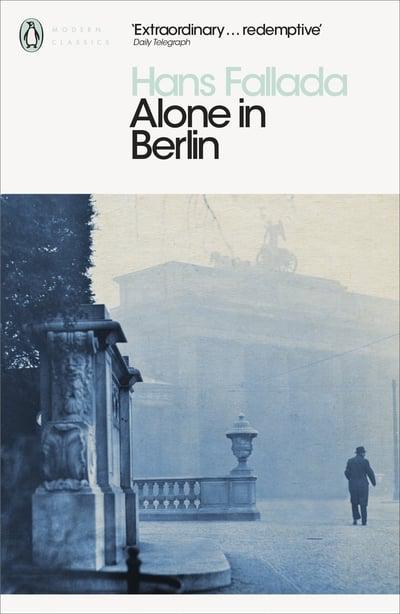
Review: Alone in Berlin-Hans Fallada. Translated by Michael Hoffman. London: Penguin Modern Classics, 2009. RRP £9.99 paperback.

"As it was, we all acted alone, we were caught alone, and every one of us will have to die alone. But that does not mean that we are alone. It doesn't matter if one man fights or ten thousand; if the one man sees he has no option but to fight, then he will fight, whether he has others on his side or not," " 

Otto Quangel

"He who thinks of renouncing "physical" struggle must renounce all struggle, for the spirit does not live without the flesh."

― Leon Trotsky, Fascism: What It Is and How to Fight It

Hans Fallada's excellent novel is set in Berlin of the 1940s. Despite being a fictional account of a German family, the book is based on the life of Otto and Elise Hampel.  Fallada, whose real name was Rudolf Ditzen, was born in 1893 in Greifswald, Germany.

To say he had a strange life would be an understatement. At the tender age of  18,he killed a friend in a duel and, according to James Buchan, spent "much of his career in psychiatric hospitals and drying-out clinics or in prison for thieving and embezzlement to support his morphine habit. In between, he worked on the land, wrote a couple of novels and held down jobs for a period on newspapers. Then, in 1944, he shot at his wife in a quarrel and was confined again to a psychiatric hospital."[1]

After this shocking episode in 1947, Aufbau-Verlag Jeder stirbt fuer sich allein ("Each dies only for himself") was published in Berlin. In many ways, this was a groundbreaking working work in that it was one of the first accounts of resistance to Nazi rule. Unfortunately, tragically Fallada died of a heart attack that same year.

The new English translation of Fallada's novel joins a growing number of recent books that have shown that there was a small but significant opposition to the Nazi regime. Fallada's book counters the lie that there was no opposition to Hitler and that all Germans supported the regime. As Bernd Reinhardt correctly points out, "Fallada's nuanced picture of daily life in the Third Reich shows the falsity of the thesis of Daniel Goldhagen and his supporters, holding that all Germans uniformly supported Hitler and the extermination of the Jews. The latest remake of Alone in Berlin (directed by Swiss actor Vincent Pérez) also rejects a collective guilt thesis. "I wanted to present this omnipresent fear. It was so thick you could cut it with a knife", the director said".[2]

Fallada's book has sold extremely well for a book written over half a century ago. The book's basic premise is that it follows the life of the Quangel family, who placed tiny handwritten postcards on stairs and hallways. Mr and Mrs Quangel distributed more than 200 such protest postcards in Berlin in 1940 following the death of their son at the front. This was done at a huge risk to them and their family. Anyone caught with the postcards would be executed. It is doubtful whether the English writer George Orwell knew of this book, but there are similarities between it and 1984.

According to Wikipedia, "Three months after its 2009 English release, it became a "surprise bestseller" in both the US and UK. It was listed on the official UK Top 50 for all UK publishers, a rare occurrence for such an old book. Hans Fallada's 80-year-old son, Ulrich Ditzen, a retired lawyer, told The Observer he was overwhelmed by the latest sales, "It is a phenomenon." Primo Levi said it is "the greatest book ever written about German resistance to the Nazis."[3]

It has now been translated into 30 languages. One reason for the book's success is the fact that the issues it addresses are contemporary ones. The struggle for social equality is very much a modern-day concern. With social inequality at its highest since the 1920s, many people are looking for answers to combat capitalism.

This English translation of the book appeared at the height of the new movement of far-right groups such as the National Front in France and Pegida and Alternative for Germany. State violence increasingly dominates everyday life. People need to know the history of the Quangels and other struggles against the Nazi's.

To conclude, while this an important book Fallada had no real perspective to counter fascism in Germany. He was no Marxist, and it is unclear whether he ever read Leon Trotsky on Germany because if he had, he would have probably produced a different book. As Trotsky said, "Fascism is nothing but capitalist reaction; from the point of view of the proletariat, the difference between the types of reaction is meaningless".[4]


[1] https://www.theguardian.com/books/2009/mar/07/alone-in-berlin-hans-fallada

[2] https://www.wsws.org/en/articles/2016/03/07/ber3-m07.html

[3] https://en.wikipedia.org/wiki/Hans_Fallada

[4] What Next? (1932)


Sunday, 6 June 2021

Review: Sophie Scholl and the White Rose by Annette Dumbach & Judd Newborn-One World publisher-ISBN-10: 1786072505.£9.99


"we will not be silent. We are your bad conscience" White Rose Leaflet

"Even the most dull-witted German has had his eyes opened by the terrible bloodbath, which, in the name of the freedom and honour of the German nation, they have unleashed upon Europe and unleash a new each day. The German name will remain forever tarnished unless finally the German youth stands up, pursues both revenge and atonement, smites our tormentors, and founds a new intellectual Europe. Students! The German people look to us! The responsibility is ours: just as the power of the spirit broke the Napoleonic terror in 1813, so too will it break the terror of the National Socialists in 1943."

White Rose Pamphlet

"To say to the Social Democratic workers: "Cast your leaders aside and join our 'non-party united front" means to add just one more hollow phrase to a thousand others. We must understand how to tear the workers away from their leaders in reality. But the reality today is the struggle against fascism. ... The overwhelming majority of the Social Democratic workers will fight against the fascists, but – for the present at least – only together with their organizations. This stage cannot be skipped".

Leon Trotsky-For a Workers' United Front Against Fascism (December 1931)

This book provides the reader with a very thorough and accessible introduction to the life of Sophie Scholl and the White Rose movement. The struggle of the Scholl family belies the common myth that there was no opposition to the Nazi's during the Second World War.

The book fails to address the reason why this opposition was so small and disparate. The fact that Hitler was able to rise to power and smash the worker's movement and the most progressive sections of the middle class was due to the betrayals of Stalinism and Social Democracy who allowed him to come to power without a shot being fired.

This history was to shape the character of the opposition to Hitler. After all, the White Rose movement was a non-violent resistance group comprised of five middle-class students at Munich University. At its heart, brother and sister Hans and Sophie Scholl, their fellow students Alexander Schmorell, Willi Graf, Christoph Probst, and their professor Kurt Huber.

Despite knowing full well that if caught, they faced instant death, they began distributing leaflets and graffiti. They were caught in 1943 by the Gestapo and, after a brief trial, executed. Sophie Magdalena Scholl was just 21 at the time of her state murder.

It is clear from the history of Scholl and the White Rose movement that it did not have a fully worked-out political agenda that drove its activities, and some of its activities against the fascist regime were dominated by their religious leanings. Scholl was heavily influenced by the theologian Augustine of Hippo. She described that her "soul was hungry".

Not everything was guided by their religious beliefs. As this statement from a White rose Pamphlet states, "Our current 'state' is the dictatorship of evil. We know that already, I hear you object, and we do not need you to reproach us for it yet again. But, I ask you, if you know that, then why don't you act? Why do you tolerate these rulers gradually robbing you, in public and in private, of one right after another, until one day nothing, absolutely nothing, remains but the machinery of the state, under the command of criminals and drunkards?"[1]They had substantial political opposition to the Nazi dictatorship.

As Tanja B. Spitzer writes, "The White Rose was a small endeavour with large consequences. Together they published and distributed six pamphlets, first typed on a typewriter, then multiplied via mimeograph. At first, they only distributed them via mail, sending them to professors, booksellers, authors, friends and others—going through phone books for addresses and hand-writing each envelope. In the end, they distributed thousands, reaching households all over Germany. Acquiring such large amounts of paper, envelopes, and stamps at a time of strict rationing without raising suspicion was problematic, but the students managed by engaging a wide-ranging network of supporters in cities and towns as far north as Hamburg and as far south as Vienna. These networks were also activated to distribute the pamphlets, attempting to trick the Gestapo into believing the White Rose had locations all across the country".[2]

They did provide a clear tactic to anyone who wanted to oppose the fascists saying "in their fifth pamphlet. "And now every convinced opponent of National Socialism must ask himself how he can fight against the present 'state' in the most effective way….We cannot provide each man with the blueprint for his acts, we can only suggest them in general terms, and he alone will find the way of achieving this end: Sabotage in armament plants and war industries, sabotage at all gatherings, rallies, public ceremonies, and organizations of the National Socialist Party. Obstruction of the smooth functioning of the war machine….Try to convince all your acquaintances. Of the senselessness of continuing, of the hopelessness of this war; of our spiritual and economic enslavement at the hands of the National Socialists; of the destruction of all moral and religious values; and urge them to passive resistance!"

While it was very difficult for the group to act amid war and being hounded by the Nazi's secret police, a major weakness of the group is that it did not appeal to the one class that could bring down the hated Nazi dictatorship, and that was the German and international working class. The defeat of the German revolution because of the betrayal of Stalinism and Social Democracy had meant the class consciousness working class in Germany had been thrown back for decades.

It is doubtful that any of the White Rose movement had read any of the great Russian Marxist Leon Trotsky works, which is a shame because even a cursory read of his work would have given the group an entirely different political outlook. As Trotsky writes "When a state turns fascist, it doesn't only mean that the forms and methods of government are changed in accordance with the patterns set by Mussolini – the changes in this sphere ultimately play a minor role – but it means, primarily and above all, that the workers' organizations are annihilated; that the proletariat is reduced to an amorphous state; and that a system of administration is created which penetrates deeply into the masses and which serves to frustrate the independent crystallization of the proletariat. Therein precisely is the gist of fascism. This was precisely the situation facing the White Rose group.

To conclude, this 75th-anniversary edition deserves a wide readership. The story of Sophie Scholl and the White Rose movement contains an important lesson for the international working class and will inspire anyone who has a burning hatred of fascism and all forms of racism. As Sophie Scholl said, "I am, now as before, of the opinion that I did the best I could do for my nation. I, therefore, do not regret my conduct and will bear the consequences that result from my conduct."


[1] See the http://whiteroseproject.seh.ox.ac.uk/

[2] https://www.nationalww2museum.org/contributors/tanja-b-spitzer