Saturday, 15 October 2011

History as Costume Drama: Allan Massie’s The Royal Stuarts and the Ideology of Dynastic Narrative


Allan Massie’s The Royal Stuarts: A History of the Family That Shaped Britain presents itself as a sweeping chronicle of a dynasty whose fortunes intersected with some of the most turbulent centuries in British history. Tracing the Stewart line from its medieval origins to Cardinal York’s death in 1807, Massie gives readers a brisk, accessible account of monarchs, marriages, feuds, betrayals, and the long Jacobite aftermath. Reviewers have praised the book’s wit, pace, and readability, and one American publisher even aimed it at audiences drawn to the early modern period through television costume drama rather than archival scholarship. That marketing choice matters: it reveals the kind of book Massie has written—and the kind of history it pushes aside.

The Dynastic Frame as Ideological Device

The three centuries Massie surveys — from the Wars of Independence and the Union of the Crowns to the civil wars, Charles I’s execution, the Cromwellian republic, the Restoration, the Glorious Revolution, and the Jacobite risings — were more than vivid episodes in a royal family saga. They were the battleground on which Britain’s shift from feudal-absolutist monarchy to capitalist state took shape: a period of revolutionary rupture, class conflict, and constitutional transformation.

Massie’s structure—one chapter per monarch—reduces this complex historical process to a series of individual lives. Personalities, loyalties, rivalries, and temperaments bear the explanatory weight that a materialist account would instead place on the struggle among an entrenched landed aristocracy, an emerging mercantile bourgeoisie, and the popular forces drawn, unevenly and often tragically, into both camps.

This is more than a matter of style; it is the ideological work of dynastic biography. By casting the Stuarts as the story’s driving force, the genre shifts historical causation from social structures to individual character. Charles I’s execution becomes a family tragedy instead of the political expression of a revolutionary crisis involving crown, Parliament, and the classes each imperfectly represented. Likewise, the Glorious Revolution appears as a courteous transfer of power rather than the consolidation of a new bourgeois order. The promotional language — “backstabbing, betrayal, and ambition gone awry” — makes the substitution explicit. Three centuries of social transformation are repackaged as the plot of a prestige drama.

Massie’s book is not isolated from its cultural moment. It belongs to a culture industry that has taught audiences to consume history as melodrama. Series such as The Tudors, The Borgias, Versailles, and Outlander have popularised a model in which the past becomes courtly spectacle, sexual intrigue, dynastic rivalry, and moralised character drama. Massie writes for that expectation. The genre shapes the book, but the market shapes it as well, offering the emotional grammar of television rather than the analytical grammar of historical explanation. That is why the book’s readability is inseparable from its weakness: it reads like entertainment, and entertainment cannot explain revolution.

The Stuart Mythos and Conservative Nostalgia

The Stuarts have long been fertile ground for conservative romanticisation. Walter Scott’s Jacobite novels, Victorian medievalism, the cult of “Bonnie Prince Charlie,” and the modern tourist economy of Highland nostalgia all participate in a cultural project that rehabilitates monarchy as a site of emotional identification rather than political domination.

Massie’s Scottish background and literary formation place his sympathies firmly within this tradition. His Jacobites are tragic, his exiled monarchs dignified, and his villains neatly assigned. The result is a narrative that softens Jacobite reaction into sentimental longing, allowing the emotional fate of a family to obscure the structural forces behind the Revolution.

What the Genre Cannot Explain

The dynastic-biography form cannot explain why the monarchy was abolished in 1649, restored in 1660, overthrown again in 1688, or why the British state that emerged differed fundamentally from the one the Stuarts inherited. It fails because it cannot account for class, structure, or material forces; it can only interpret history through character, temperament, and family drama. For all its craft, Massie’s book therefore becomes less an explanation of the period than a way of avoiding one.

Even sympathetic reviewers have pointed to the book’s uneven evidentiary base: a blend of archival material, literary sources, plays, novels, and earlier histories. That mixture makes the narrative readable but less reliable. Sharper critics have also noted Massie’s tendency to cast some figures as heroes and others as villains without the analytical support serious scholarship demands. These are not incidental defects, but symptoms of a genre that values narrative satisfaction over historical explanation.

Popular dynastic history sells because it offers readers what academic history cannot—and should not—provide: the comforting illusion that great upheavals are ultimately family stories on a grand scale. It makes the past feel emotionally accessible, morally clear, and narratively ordered. The strategy is effective, but deeply distorting. A reader may finish The Royal Stuarts knowing which monarch quarrelled with which sibling, yet still not understand why a social order was overturned, briefly abolished, and restored on fundamentally altered terms.

The Royal Stuarts is a well‑crafted, briskly paced example of a genre built to entertain rather than explain. It succeeds brilliantly on those terms — hence the enthusiastic notices from readers approaching the Stuarts as costume drama rather than as a chapter in the history of the English Revolution.

But readers seeking to understand why the Stuart story cannot be separated from civil war, regicide, and the revolutionary transformation of crown, Parliament, and the emerging capitalist order will need to look elsewhere: to the structural, class-based history this genre works to obscure. Massie has written a family saga. Britain’s history between the fifteenth and eighteenth centuries was not a family saga. It was a revolution.

Sources and Bibliography

Primary Sources

  • Acts and Ordinances of the Interregnum, 1642–1660. London: HMSO, various editions.
  • Calendar of State Papers, Domestic Series, 1603–1714. London: Public Record Office.
  • Clarendon, Edward Hyde. The History of the Rebellion and Civil Wars in England. Oxford: Oxford University Press, various editions.
  • Cromwell, Oliver. Letters and Speeches. Edited by Thomas Carlyle. London: Chapman & Hall, 1845.
  • Milton, John. The Tenure of Kings and Magistrates (1649).
  • The Memoirs of James II. Edited by J.S. Clarke. London: Rivington, 1816.
  • Stuart Royal Correspondence, British Library Manuscripts, various collections.

Secondary Sources: Stuart History and the English Revolution

  • Hill, Christopher. The Century of Revolution, 1603–1714. London: Routledge, 1961.
  • Hill, Christopher. The World Turned Upside Down: Radical Ideas During the English Revolution. London: Penguin, 1972.
  • Hill, Christopher. God’s Englishman: Oliver Cromwell and the English Revolution. London: Penguin, 1970.
  • Manning, Brian. The English People and the English Revolution. London: Bookmarks, 1991.
  • Manning, Brian. Aristocrats, Plebeians and Revolution in England, 1640–1660. London: Pluto Press, 1996.
  • Pocock, J.G.A. The Ancient Constitution and the Feudal Law. Cambridge: Cambridge University Press, 1957.
  • Russell, Conrad. The Causes of the English Civil War. Oxford: Clarendon Press, 1990.
  • Sharpe, Kevin. The Personal Rule of Charles I. New Haven: Yale University Press, 1992.
  • Harris, Tim. Revolution: The Great Crisis of the British Monarchy, 1685–1720. London: Penguin, 2006.
  • Harris, Tim. Restoration: Charles II and His Kingdoms. London: Allen Lane, 2005.
  • Coward, Barry. The Stuart Age: England, 1603–1714. London: Longman, 1980.

Jacobitism and the Stuart Afterlife

  • Lenman, Bruce. The Jacobite Risings in Britain, 1689–1746. London: Eyre Methuen, 1980.
  • Pittock, Murray. The Myth of the Jacobite Clans. Edinburgh: Edinburgh University Press, 1995.
  • Pittock, Murray. Jacobitism. London: Palgrave Macmillan, 1998.
  • Szechi, Daniel. The Jacobites: Britain and Europe, 1688–1788. Manchester: Manchester University Press, 1994.

Popular History, Culture Industry, and Historical Representation

  • Hobsbawm, Eric. On History. London: Weidenfeld & Nicolson, 1997.
  • Hobsbawm, Eric, and Terence Ranger (eds.). The Invention of Tradition. Cambridge: Cambridge University Press, 1983.
  • Williams, Raymond. Culture and Society, 1780–1950. London: Chatto & Windus, 1958.
  • Williams, Raymond. The Long Revolution. London: Chatto & Windus, 1961.
  • Adorno, Theodor, and Max Horkheimer. Dialectic of Enlightenment. Stanford: Stanford University Press, 2002 (orig. 1944).
  • Benjamin, Walter. Illuminations. London: Pimlico, 1999.
  • Cannadine, David. Ornamentalism: How the British Saw Their Empire. London: Allen Lane, 2001.
  • Schama, Simon. A History of Britain. London: BBC Books, 2000–2002 (for contrast with dynastic narrative).

Historiography and Marxist Approaches

  • Marx, Karl. The Eighteenth Brumaire of Louis Bonaparte.
  • Marx, Karl. Capital, Vol. I.
  • Trotsky, Leon. The History of the Russian Revolution. London: Pluto Press, various editions.
  • Dobb, Maurice. Studies in the Development of Capitalism. London: Routledge, 1946.
  • Wood, Ellen Meiksins. The Origin of Capitalism. London: Verso, 1999.
  • Hill, Christopher. Puritanism and Revolution. London: Secker & Warburg, 1958.
  • Morton, A.L. A People’s History of England. London: Lawrence & Wishart, 1938.

Works on the Stuart Dynasty and Royal Biography

  • Massie, Allan. The Royal Stuarts: A History of the Family That Shaped Britain. London: Jonathan Cape, 2010.
  • Fraser, Antonia. King Charles II. London: Weidenfeld & Nicolson, 1979.
  • Fraser, Antonia. The Gunpowder Plot. London: Weidenfeld & Nicolson, 1996.
  • Weir, Alison. Britain’s Royal Families: The Complete Genealogy. London: Bodley Head, 1989.
  • Somerset, Anne. Queen Anne: The Politics of Passion. London: HarperCollins, 2012.

Suggested Further Reading for a Materialist Interpretation of the Stuart Period

  • Callinicos, Alex. The Revolutionary Road to Socialism. London: Bookmarks, 1983.
  • Callinicos, Alex. Making History: Agency, Structure, and Change in Social Theory. Leiden: Brill, 2004.
  • Hill, Christopher. Economic Problems of the Church. Oxford: Clarendon Press, 1956.
  • Manning, Brian. 1649: The Crisis of the English Revolution. London: Bookmarks, 1992.
  • Holmes, Clive. Why Was Charles I Executed? London: Hambledon, 2006.


Friday, 30 September 2011

Adamson review: a response

John Adamson, The Noble Revolt. The Overthrow of Charles I. (Weidenfeld & Nicolson. London. 2007. Xxii + 742 pages.)

I have just received two responses to my blog review of John Adamson’s book the Noble Revolt and have now published both. Suffice to say I will in time reply to some their points. While putting Adamson's work in a wider context of new research on the Civil War. One question I will attempt to answer is does it break new ground?

From Chris Thompson

I have now had the opportunity to read Keith Livesey’s comments on his blog (“A Trumpet of Sedition”, 26 September, 2011) regarding John Adamson’s book in detail. Keith Livesey has an intense interest in the events of the 1640s and favours a Marxist interpretation as readers of his blog will know. I enjoy reading what he has to say although I am often sceptical about his claims. On this occasion, however, I fear that he is seriously mistaken.

Let me begin with the historiographical issues he raises. Nineteenth and early-twentieth century Whig historians argued that the English Civil Wars of the 1640s were the result of constitutional and religious struggles that paved the way for the establishment of a limited monarchy alongside Parliamentary supremacy, the rule of law, freedom of the press and religious toleration after the Glorious Revolution of 1688-1689. These were the Whigs’ themes from the time of Hallam and Macaulay to that of G.M.Trevelyan. This argument was rejected by Marxist historians and those historians influenced by Marx in the period before the Second World War and after it.

One thinks of figures like R.H.Tawney, Christopher Hill and others who believed that antecedent economic and social changes explained the origins and course of the ‘English Revolution’. Of course, there were historians like Hugh Trevor-Roper, who was definitely not a Marxist, but who had his own socio-economic explanation to advance in the late-1940s and early-1950s.
The ‘storm over the gentry’ and contrasting claims about the fortunes of the peerage led to the great outpouring of theses and published works on the landed elites and on counties in the 1950s and 1960s. It is fair to say that this body of research left earlier arguments about the economic and social causes of the English Civil Wars or Revolution still undetermined. The controversy had run into the sand.

It was in this context that Conrad Russell observed in 1973 that social change explanations of this kind had failed. He left open the possibility that new explanations of this sort might be advanced. Russell himself and those historians advocating a new approach to the religious and political history of the early Stuart period were concerned with the causes of the breakdown in Stuart England before 1640: Theodore Rabb denominated them – misleadingly in my view – as ‘revisionists’. It was against the claims of Russell that historians like Richard Cust, Ann Hughes, Peter Lake and Tom Cosgwell, i.e. the post-revisionists, reacted in the 1980s. But there was a second group of historians, including John Morrill and Mark Kishlansky, engaged more or less simultaneously in re-evaluating the conflicts of the 1640s. These historians, whether or not they constituted one or two groups of ‘revisionists’, were certainly not mainly right-wing in their political persuasions. Russell himself, Ann Hughes, Richard Cust and John Morrill would have rejected such a description out of hand. In any case, by 1991 when Russell’s two books on the origins of the English Civil War and the fall of the British monarchies were published, revisionism and the reaction against it were over. New concerns over images, propaganda and the public sphere were coming to preoccupy seventeenth-century historians.

There was no attempt in the 1970s by the so-called revisionists to put forward explanations entailing “a rejection of both the Marxist and Whig views of English Civil War historiography” or “to pour scorn on Marxist theory”. Whig views were regarded as methodologically flawed and Marxist ones as anachronistic and irrelevant. They had ceased to matter. It is certainly wrong to claim that John Adamson’s “politics and historical attitudes were formulated during the Thatcher era.” John Adamson was a graduate of the University of Melbourne and arrived in Cambridge long after Mrs Thatcher had become Prime Minister. There is nothing in his book to suggest that he viewed the main actors in the period before the end of January, 1642 as reacting blindly to events or that he fails to explain or does not want to explain what provoked this revolt of the nobles and their allies. Equally clearly, he has nothing in its text or in the introduction to the volume of essays he edited in 2009, The English Civil War, to suggest any denigration of Oliver Cromwell or that he particularly admired King Charles I.

When Keith Livesey says that the book “contains significant omissions which include the significant role played by the Earl of Essex as Parliamentary commander after the outbreak of the civil war, the creation of the Royalist party, the significance of the New Model Army, the military defeat and elimination of the King, and the abolition of the House of Lords”, the chronological and logical fallacies involved in such claims are all too clear. None of these things had happened by the end of January, 1642 and thus fell outside the scope of John Adamson’s book. They will, no doubt, be dealt with in his later volumes.

Take, for example, the proposition advanced in his review that “Adamson does not touch upon any of the controversies over the war” and the contention four paragraphs later that he “accused some historians of relying too much on large abstract forces and opposed a downplaying of the role of the individual. He said”, so Keith Livesey argues, “he did not agree that long term views got us anywhere or that it was a bourgeois revolution. He [Adamson] felt that this “economic determinist” viewpoint did not explain too much.” 

The two claims are contradictory. But, if one reads Adamson’s book carefully, it is possible to see that he did engage with earlier historians’ interpretations – e.g. throughout the footnotes and in his epilogue (Pages 513-516) and that the bulk of his introduction to the 2009 volume of essays considers historiographical issues as a prelude to the work of his contributors. Nowhere in the book is there any comment to link the decline of Marxist influence on Civil War historiography with the fall of the Berlin Wall or to explain the English Revolution as a result of Charles I’s inexperience and vanity. Furthermore, no one can massage the egos of dead aristocrats.

In fact, almost all of Keith Livesey’s claims are either unfounded or untenable. I understand why, as a Marxist, he regrets its passing as an influence on the study of the events of the 1640s and 1650s since the early-1970s and the great days of Christopher Hill. That was probably inevitable as one generation of historians reacts against the claims of the preceding one. I happen to think that this is a good, positive development which has led to some profoundly important new lines of enquiry. John Adamson’s work has contributed very largely to this process and will, I expect, continue to do so into the future. His views on politics, whatever they may be, are irrelevant to the importance of his research just as they are to the work of historians of the left. We are all engaged in a continuing debate about these issues, a debate to which, alas, this review has contributed very little.


Tuesday, 27 September 2011

mercuriuspoliticus commented on The Noble Revolt: The Overthrow of Charles I by John Adamson 576 pp, Weidenfeld & Nicolson,


This was a thought-provoking post but I'm not sure I would agree with all of what you say about Adamson's work here. (You will probably have guessed that having read my own review of the book!). I think it's a bit unfair to say it's light on analysis: the sustained way in which Adamson unpicks the factional manoeuvrings behind the Junto, and particularly the complicated Anglo-Scottish-Irish connections, are to my mind highly analytical and considered.

And he does devote lots of space, too, to understanding why a certain section of peers and MPs were so hostile to Charles I's policies during the Personal Rule. he does not arrive at a class-based explanation of this group's actions, but on the evidence I think he's right to locate their opposition in political and religious ideologies: or to put it another way, to prioritise superstructure rather than base.

Perhaps it's fairer to say that Adamson's book does not really engage with those below the level of the political class. There are moments when he takes a rather monolithic view of politicians controlling the London crowd: it was probably more complicated than this, and while some protests in 1641 were I'm sure engineered or at least tacitly supported by the Junto grandees, many more will have owed their origins to the indepenent political agency of those participating in them. But to carry out a sustained analysis of the vertical links between politicians and "people" would be a very different work of history, and add hundreds of pages to what is already a monster of a book.

And the book does stop in January 1642, which means that its chronological scope can't really cover some of the things you mention in your review. Within these limits I think it is absolutely reasonable for Adamson to argue that the outbreak of the war - in the sense of Charles and Parliament coming to blows - is driven by the sustained efforts of the Junto to achieve a quasi-republican settlement. Yes of course when it comes to recruiting armies, to choosing sides etc this doesn't look at the motivations of working people, but in terms of Adamson's focus - what was going on in London/Edinburgh/Dublin politics that caused the rift between King and Parliament - the book, for me, breaks new ground.

I'm sure you're right that Adamson has some sympathies with Charles I (and Strafford, too) - read his chapter in Niall Ferguson's "Virtual History" for a rollicking attempt to imagine the ancien regime in England continuing into the late eighteenth century had Charles only been able to defeat the Scots. But I'm not sure you can argue that he denigrates Cromwell because of his politics. See for example his chapter in John Morrill's "Oliver Cromwell and the Puritan Revolution", in which he conducts a close and considered analysis of Cromwell's attitudes to Parliament and his behaviour in the Long Parliament.


Monday, 26 September 2011

A Revolution Without a Revolution: John Adamson’s The Noble Revolt

John Adamson’s The Noble Revolt: The Overthrow of Charles I is, by its own standards, a formidable achievement: a densely researched and elegantly written account of the eighteen months from May 1640 to January 1642, when England moved from Charles I’s personal rule to the edge of civil war. It is also a significant intervention in a long-running historiographical debate. Its political purpose has received surprisingly little attention in mainstream reviews, but it should be stated plainly: Adamson offers one of the most sophisticated recent efforts to displace the Marxist interpretation of the English Revolution and replace it with an aristocratic, essentially conservative account of political change.

Adamson places a close circle of peers — including the Earls of Warwick and Bedford and their allies — at the heart of the crisis of 1640–42. He argues that this “Junto” drove events: first by encouraging the Scottish Covenanter invasion that forced Charles I to recall Parliament, then by working persistently in the House of Lords to reshape the monarchy into a “Venetianised” commonwealth controlled by the aristocracy. In this account, the Lords rather than the Commons held the initiative, and events were pushed to breaking point by aristocratic interest and constitutional strategy, not by religious conviction or popular mobilisation.

As narrative history, the book is highly effective. Adamson’s extensive archival research — including private correspondence, estate papers, and parliamentary diaries overlooked by earlier historians — lets him trace the Junto’s activities in precise detail. His portrayal of Charles I is equally unsparing: not the unfortunate monarch of schoolbook tradition, but a stubborn and inept ruler whose repeated misjudgements intensified the crisis. Few readers will come away without a clearer sense of how badly the king misunderstood the political situation.

John Adamson and the Revisionist Project

Published in 2007, John Adamson’s The Noble Revolt was more than a major archival reconstruction of the crisis of 1640–42; it represented the culmination of a historiographical current that had been gaining strength for over thirty years. To understand the book’s claims, omissions, and political implications, it must be read within the revisionist and post-revisionist tradition that has reshaped studies of the English Revolution since the 1970s. That tradition arose in direct response to the Marxist interpretation associated with Christopher Hill and his circle, and it increasingly sought to replace the structural, class-based analysis that dominated mid-twentieth-century scholarship.

The Marxist Moment: Hill and the Structural Interpretation

From the 1940s to the 1970s, Christopher Hill’s work dominated interpretations of the English Revolution. In The English Revolution 1640, The Century of Revolution, and The World Turned Upside Down, Hill argued that the civil war was a bourgeois revolution: a struggle between a rising commercial and gentry class and a monarchy tied to a declining feudal order. For Hill, the House of Commons, rather than the Lords, was the institutional centre where these forces came together. Religion, ideology, and popular mobilisation were therefore expressions of deeper social change.

Hill’s interpretation was capacious: it made room for the ideological ferment of Puritanism, the radicalism of sectarian movements, and the political assertiveness of London. But its foundation was structural. The English Revolution was not an aristocratic quarrel; it was a conflict rooted in class dynamics and the transition to capitalism.

By the late 1970s, this framework had become the orthodoxy against which a younger generation of historians reacted. Revisionism developed in opposition to Hill’s structuralism. Its leading figures — including John Morrill, Conrad Russell, and Anthony Fletcher — argued that the English Civil War was not a revolution but a political crisis shaped by contingent causes: religious conflict, constitutional misunderstanding, and Stuart misgovernment. They rejected long-term social explanations and instead emphasised short-term political events.

The revisionist project had several defining features. It rejected structural explanations, denying that class conflict or economic change played a decisive role and instead stressing the fluidity of political alignments. It placed religion at the centre of the crisis, especially in Morrill’s account, where conflict arose from competing visions of Protestantism rather than class power. It also rehabilitated the monarchy by portraying Charles I less as the representative of a feudal order than as a ruler constrained by circumstance, poor advice, or irresolvable religious divisions. Finally, it minimised popular agency, treating crowds, sectarians, and London radicals as episodic disturbances rather than structural forces.

Revisionism was not politically neutral. It emerged in a period when Marxist interpretations were losing institutional ground, and it offered a vision of English history that was orderly, constitutional, and fundamentally non‑revolutionary — a comforting narrative for a nation uneasy with the idea of having undergone a revolution at all.

Post-Revisionism and the Aristocratic Turn

By the 1990s, revisionism had begun to change. Post-revisionists kept parts of the critique of Marxism but reintroduced political agency and intent, focusing on elite strategy, factional organisation, and aristocratic networks. Adamson’s work emerged from this context. His early articles, and later The Noble Revolt, firmly belong to this post-revisionist moment. His central move is to shift political initiative from the Commons to a small group of peers — not merely changing the emphasis, but redrawing the political map of the early 1640s.

Where Hill treated the Commons as the institutional expression of a rising class, Adamson identifies the Lords as the decisive arena of political action. Where Marxists emphasised structural forces, he foregrounds aristocratic calculation; where earlier revisionists stressed contingency, he stresses elite strategy. This marks Adamson’s distinctive contribution: the “baronial context.” Unlike earlier revisionists, who often framed their work as a corrective to Marxist excess, Adamson presents his account as a replacement. The Warwick-Bedford circle is not one factor among many, but the central engine of political change.

This confidence rests on three methodological pillars. First, Adamson’s archival immersion — especially his use of private correspondence and estate papers — enables him to reconstruct aristocratic networks in exceptional detail, giving the Junto the appearance of a hidden hand directing events. Second, his tight focus on eighteen months allows aristocratic manoeuvring to appear as the decisive causal chain, while broader social forces recede into the background. Third, his limited engagement with Marxist historiography lets him displace that tradition indirectly, presenting his interpretation as if it emerged naturally from the sources. The strategy is rhetorically powerful, but it obscures the interpretive choices behind the narrative.

Adamson’s work is more than a scholarly intervention; it forms part of a broader ideological project. Revisionist and post-revisionist historians have repeatedly sought to domesticate the English Revolution, recasting it as a constitutional crisis rather than a revolutionary rupture. Adamson’s emphasis on aristocratic initiative strengthens this vision of English history as polite, orderly, and essentially non-revolutionary. His “Venetianised” commonwealth is an oligarchic ideal of stability, not an acknowledgement of the social upheaval that defined the 1640s. In this sense, The Noble Revolt marks the culmination of a long historiographical counter-revolution: an effort to strip the English Revolution of its revolutionary content.

Adamson as the Revisionist Apex

John Adamson stands at the apex of the revisionist tradition. He has produced its most sophisticated narrative, its most detailed archival reconstruction, and its most confident challenge to Marxist historiography. But his work also reveals the limits of the revisionist project. By focusing so narrowly on aristocratic manoeuvring, Adamson cannot explain the broader social forces that made the English Revolution possible.

What Adamson leaves largely unstated, but what deserves emphasis, is that The Noble Revolt directly challenges the Marxist tradition associated above all with Christopher Hill. Hill and his contemporaries saw the English Revolution as a genuine bourgeois revolution: a clash between a rising commercial and gentry class and a declining feudal-absolutist monarchy, with the House of Commons serving as the institutional expression of this emerging social force. In that view, the civil war was not an aristocratic dispute but a structural conflict rooted in class transformation.

Adamson’s book seeks to overturn that interpretation. It shifts political initiative away from the Commons and the broader social forces Hill emphasised, locating it instead in a narrow aristocratic clique driven by dynastic and constitutional aims. As a result, the larger class dynamics of early modern England — commercial expansion, gentry assertiveness, and Puritan ideological ferment — are displaced by the manoeuvres of a handful of grandees.

This is revisionism in its fullest form. Adamson belongs to the revisionist and post-revisionist tradition that has shaped English Civil War scholarship for decades, a tradition that has repeatedly sought to drain the period of its revolutionary significance. His depiction of British political change as characteristically “polite and orderly,” especially when contrasted with continental upheaval, makes the ideological stakes clearer than most reviewers have recognised. Whether consciously or not, this is history written to reassure a national self-image uneasy with the idea of an English revolution.

The book’s central weakness follows directly from its polemical ambition. By confining its account so tightly to the intrigues of a small group of peers, Adamson produces a compelling story about aristocratic manoeuvring — but only by systematically bracketing off the wider social forces that made that manoeuvring effective.

The London crowds that besieged Parliament and Whitehall in the winter of 1641–42 appear only as background noise, rather than as political actors whose mobilisation influenced parliamentary strategy. The City’s merchant and financial elites, whose interest in limiting royal fiscal power was central to the crisis, are largely absent. Deep anti-Catholic feeling across English society — a crucial force behind political mobilisation — is treated as atmosphere rather than structure. The provincial gentry, indispensable to any constitutional settlement, scarcely register.

In later writing, Adamson has acknowledged that the events of 1640–42 were “no mere barons’ war” and that the aristocratic context was only one factor among many. Yet this concession comes too late to alter a book whose narrative structure is designed to foreground the aristocracy while pushing other forces to the margins.

The problem is deepened by the book’s near silence on historiographical controversy. A work that aims to overturn an established tradition should engage that tradition directly, but Adamson does not. The Marxist account he implicitly challenges is never addressed as an intellectual position; instead, it is displaced by archival detail. This is rhetorically effective, allowing his thesis to seem to arise naturally from the sources, but it is ultimately evasive. Archival depth does not eliminate interpretation.

What the Book Achieves — and What It Cannot Explain

This does not diminish the book’s real achievements. Adamson demonstrates more clearly than any earlier historian the existence, significance, and political role of the Warwick-Bedford circle. His reconstruction of aristocratic strategy is meticulous and often compelling, and any serious student of the period must now confront the evidence he has brought together.

Yet the larger claim — that the crisis of 1640–42 was essentially a baronial revolt — is unconvincing. The English Revolution was not the work of peers alone. It emerged from the interaction between aristocratic initiative and wider class forces: the assertiveness of the Commons, London’s mobilisation, Puritan ideology, the City’s fiscal interests, and the structural tensions of a changing society. Adamson explains a faction; he does not explain a revolution.

The Noble Revolt is a major achievement in archival research and narrative history. It reveals the importance of an aristocratic faction whose role in the crisis has often been underestimated. Yet its effort to recast the English Revolution as a polite, oligarchic episode — emptied of class conflict and popular agency — should be seen clearly: it is the most sophisticated recent expression of a revisionist project that seeks to domesticate England’s revolutionary century. The book succeeds brilliantly as a study of faction, but fails as an explanation of revolution.

Sources and Bibliography

Primary Works by John Adamson

  • Adamson, John. The Noble Revolt: The Overthrow of Charles I. London: Weidenfeld & Nicolson, 2007.
  • Adamson, John. “The Baronial Context of the English Civil War.” In The English Civil War: Conflict and Contexts, 1640–49, edited by John Adamson, 1–31. London: Palgrave Macmillan, 2009.
  • Adamson, John. “The English Nobility and the Projected Settlement of 1641–42.” Historical Journal 30, no. 3 (1987): 567–602.
  • Adamson, John. “The Making of the Ancien Régime: The Aristocracy and the Origins of the English Civil War.” Past & Present 122 (1989): 52–89.

Marxist and Structural Interpretations

  • Hill, Christopher. The English Revolution 1640. London: Lawrence & Wishart, 1940.
  • Hill, Christopher. The Century of Revolution, 1603–1714. London: Thomas Nelson, 1961.
  • Hill, Christopher. The World Turned Upside Down: Radical Ideas During the English Revolution. London: Penguin, 1972.
  • Hill, Christopher. Puritanism and Revolution. London: Secker & Warburg, 1958.
  • Hill, Christopher. Change and Continuity in Seventeenth‑Century England. London: Weidenfeld & Nicolson, 1974.
  • Ashton, Robert. The English Civil War: Conservatism and Revolution, 1603–1649. London: Weidenfeld & Nicolson, 1972.
  • Brenner, Robert. “The Agrarian Roots of European Capitalism.” Past & Present 97 (1982): 16–113.
  • Manning, Brian. The English People and the English Revolution. London: Heinemann, 1976.
  • Manning, Brian. The Far Left in the English Revolution. London: Bookmarks, 1999.

Revisionist Scholarship

  • Morrill, John. Revolt of the Provinces: The People of England and the Tragedies of War, 1630–1648. London: George Allen & Unwin, 1976.
  • Morrill, John. “The Religious Context of the English Civil War.” Transactions of the Royal Historical Society 34 (1984): 155–178.
  • Russell, Conrad. The Causes of the English Civil War. Oxford: Clarendon Press, 1990.
  • Russell, Conrad. Parliamentary History in Perspective, 1604–1629. London: Hambledon Press, 1981.
  • Cust, Richard. Charles I: A Political Life. London: Longman, 2005.
  • Fletcher, Anthony. The Outbreak of the English Civil War. London: Edward Arnold, 1981.
  • Sharpe, Kevin. The Personal Rule of Charles I. New Haven: Yale University Press, 1992.
  • Sharpe, Kevin. Politics and Ideas in Early Stuart England. London: Hambledon Press, 1989.

Post‑Revisionist and Aristocratic‑Focused Works

  • Kishlansky, Mark. Parliamentary Selection: Social and Political Choice in Early Modern England. Cambridge: Cambridge University Press, 1986.
  • Braddick, Michael. God’s Fury, England’s Fire: A New History of the English Civil Wars. London: Allen Lane, 2008.
  • Braddick, Michael, and David L. Smith, eds. The Experience of Revolution in Stuart Britain and Ireland. Cambridge: Cambridge University Press, 2011.
  • Smith, David L. Constitutional Royalism and the Search for Settlement, c.1640–1649. Cambridge: Cambridge University Press, 1994.
  • Woolrych, Austin. Britain in Revolution, 1625–1660. Oxford: Oxford University Press, 2002.

Works on Popular Mobilisation, London, and Social Forces

  • Pearl, Valerie. London and the Outbreak of the Puritan Revolution: City Government and National Politics, 1625–43. Oxford: Oxford University Press, 1961.
  • Reeve, L. J. Charles I and the Road to Personal Rule. Cambridge: Cambridge University Press, 1989.
  • Underdown, David. Revel, Riot and Rebellion: Popular Politics and Culture in England, 1603–1660. Oxford: Oxford University Press, 1985.
  • Underdown, David. Fire from Heaven: Life in an English Town in the Seventeenth Century. London: Pimlico, 1992.
  • Capp, Bernard. The Fifth Monarchy Men: A Study in Seventeenth‑Century English Millenarianism. London: Faber & Faber, 1972.

General Histories and Contextual Works

  • Hutton, Ronald. The British Republic, 1649–1660. London: Macmillan, 1990.
  • Gentles, Ian. The English Revolution and the Wars in the Three Kingdoms, 1638–1652. London: Pearson, 2007.
  • Elliott, J. H. The Old World and the New, 1492–1650. Cambridge: Cambridge University Press, 1970.
  • Hexter, J. H. The Reign of King Pym. Cambridge, MA: Harvard University Press, 1941.
  • Trevor‑Roper, Hugh. Religion, the Reformation and Social Change. London: Macmillan, 1967.

Archival and Documentary Collections

  • The Journals of the House of Commons, vols. 2–3. London: HMSO.
  • The Journals of the House of Lords, vols. 4–5. London: HMSO.
  • Calendar of State Papers Domestic, Charles I. London: HMSO.
  • The Letters and Papers of the Earl of Warwick, Warwickshire Record Office.
  • The Bedford Papers, British Library, Additional Manuscripts.

Optional: Works on Historiography and Method

  • Hexter, J. H. “Storm over the Gentry.” In Reappraisals in History, 117–160. London: Longmans, 1961.
  • Hill, Christopher. “Marxism and History.” In Change and Continuity in Seventeenth‑Century England, 3–22.
  • Braddick, Michael. “Revisionism Revisited.” History Compass 7, no. 5 (2009): 1374–1394.
  • Hughes, Ann. The Causes of the English Civil War. London: Macmillan, 1991.


Tuesday, 20 September 2011

A Solid Classroom Guide to a Turbulent Century: Reviewing Graham E. Seel’s Regicide and Republic

Few periods in English history resist concise treatment as stubbornly as the one Graham E. Seel tackles in Regicide and Republic. Between 1603 and 1660, England lurched from the accession of a new dynasty through civil war, the public execution of a reigning monarch, an unprecedented republican experiment, and finally a restored monarchy. The religious, political, and constitutional upheavals of these decades have generated a century of scholarly dispute. That Seel compresses this into a short, accessible volume for AS and A Level students — without flattening its complexity — is the book’s central achievement.

A clear guide through a difficult story

Seel excels where an introductory text must: making the core drama legible. He traces the breakdown between crown and parliament, the descent into civil war, and the extraordinary spectacle of a nation trying and executing its king with clarity and restraint. His prose neither patronises newcomers nor overwhelms them with qualification.

The book’s scope is also commendably broad. A dedicated chapter on economic pressures — often sidelined in introductory treatments — reminds readers that the crisis was driven not only by liturgy and royal prerogative but by taxation, trade, and material grievance. It is a small but meaningful corrective.

Cambridge University Press supports the text with clean layout and well‑chosen illustrations that genuinely aid comprehension — a detail that matters more than it should in textbooks at this level.

A historiographical snapshot of its moment

Where the book most visibly shows its age is in its historiography. Published in 2001, it reflects the dominance of revisionist and post‑revisionist scholarship, which challenged older Whig and Marxist narratives of long‑term constitutional or class conflict in favour of contingent, short‑term explanations. Seel’s citations lean heavily in this direction. This is less a flaw than an accurate reflection of the field at the time, and because revisionism has remained influential, the book has aged better than many tied to more fleeting fashions.

Still, students seeking a fuller map of competing schools of interpretation will find the treatment thin. Seel sketches the major camps clearly enough to orient a newcomer but does not probe them deeply. His most valuable methodological contribution is a simple one: urging students to interrogate the historian before trusting the history — a reminder that every account of this period, including his own, comes from somewhere.

Verdict

As an introductory text, Regicide and Republic succeeds on its own terms. It renders an extraordinarily complex sequence of events intelligible without falsifying its intricacy, gives economic factors their due, and nudges students toward source‑critical thinking rather than rote memorisation. It is not a work of original scholarship, and its historiographical framing reflects a specific moment in the discipline. But for its intended purpose — providing A Level students with a clear, well‑illustrated, and reasonably rigorous foothold on the years 1603 to 1660 — it remains a solid and dependable choice.

Regicide and Republic: England 1603–1660 by Graham E. Seel was published by Cambridge University Press in 2001 as part of the Cambridge Perspectives in History series.


Tuesday, 6 September 2011

How to Do Good to Many: The Public Good Is the Christian’s Life – 13 Nov 2018by Richard Baxter & Jordan J Ballor (Editor) Christian's Library Press


Richard Baxter
In his book, Richard Baxter and Puritan Politics Richard Schlatter shows that figures like Baxter have been significantly overlooked by historians of both left and right persuasions. Schlatter is correct when saying that the English Civil War was one of a half dozen creative periods of world history. While figures such as Baxter have faded into the background, the Civil War still provokes great interest. The purpose of this short article is to go some way to redress this imbalance.

Richard Baxter was born in 1615 in the village of Rowton, Shropshire. Baxter described his father as "a mean Freeholder". Baxter's early family life was hard, and the family struggled with debt. Although much of this was brought on by a family trait of addiction to gambling.

Despite this wild beginning, the family soon began to adopt the Puritan lifestyle and philosophical outlook. Baxter later acknowledged his fathers as the "Instrument of my first Convictions, and Approbation of a Holy Life'. Baxter was in many ways a representative of the archetypal lower-middle-class layer that saw Puritanism as both a moral and philosophical outlook. His father also bred into his son that hostility to Puritanism stems from "mere Malice' and that 'Godly People were the best'.

Baxter's own 'vehement desires' had been to proceed from school to university to achieve 'Academick Glory', and throughout his life, he regretted his lack of university education and pointed to his 'wanting Academical Honours' as a mark of his insufficiency as a minister.

Despite his lowly academic status, how does one account for the fact that Baxter "became one of the most learned of seventeenth-century divines." Baxter himself probably puts this down to his devotion to God. But while not downplaying the fact that Baxter was undoubtedly a gifted speaker and writer Baxter was also moved by the massive social, political and religious upheavals brought about by the English revolution.

While much of Baxter's thought was cloaked in religious trappings, his political and philosophical writings should be studied today because they play an important part in our understanding of the events of the 17th-century English revolution.

Baxter even early on in his life, engendered dislike and hatred from many sides of the class struggle. One example came in 1642 when a churchwarden tried to impose a parliamentary order for the demolition of any outstanding images of the persons of the Trinity or the Virgin Mary. Baxter was held by many accountable for this order and was targeted by 'a Crew of the drunken riotous Party of the Town'. Baxter clearly feared for his life at this time. The tensions and hostilities surrounding the outbreak of civil war further heightened feelings: 'a violent Country Gentleman' passing Baxter in the street' stopt and said, There goeth a Traitor'.

Baxter politically was on the right-wing of the Presbyterians. He never gave his full backing to Cromwell and never really adhered to his ideas about the war and later the Commonwealth. One thing is also certain is that he was hostile to left-wing independents such as Hugh Peters. He reserved his anger for "sectaries" such as Thomas Rainborow. As for the Levellers and Diggers, he saw them as nothing more than "tools of Anabaptists', in fact, anyone who sought to enfranchise a wider selection of the population were labelled Anabaptists.

Baxter was a prodigious writer turning out more than 130 books (the exact figure depends upon how works published in a variety of forms are counted), several of them folios over 1 million words in length. The civil war produced an outpouring of writing that had never been seen previously in England and would match any contemporary event. According to Christopher Hill "People especially Puritans began to utilise the press more often than not secretly to forward their thoughts and views on the nature of religion politics and philosophy. It has been said with his volume of work Baxter "was the first author of a string of best-sellers in British literary history". The political theorist, Hobbes, describes how the Presbyterian merchant class of the city of London was the first centre of sedition, trying to build a state-governed like the republics of Holland and Venice, by merchants for their interests. (The comparison with the bourgeois republics is constantly recurring in Parliamentarian writings.) Mrs Hutchinson, the wife of one of Cromwell's colonels, said all were described as Puritans who "crossed the views of the needy courtiers, the encroaching priests, the thievish projectors, the lewd nobility and gentry . . . whoever could endure a sermon, modest habit or conversation, or anything good."

Baxter claimed no credit for his letter writing. Again he put his thoughts down to a gift from God. He was, however, a compulsive letter writer. His 1200 letters were sent to over 350 people. This amount of letter writing bears testimony to not only Baxter's love of life but give us a deeper insight into the culture and politics during the civil war.

According to one writer "The largest single group among Baxter's correspondence consists of some seventy men who became nonconformist ministers at the Restoration, but the interest of the letters is not confined to the history of nonconformity, ecclesiastical affairs, or theological controversy. Baxter was an acute enquirer into matters arcane and mundane, inveterately interested in both public affairs and individuals' experience, encyclopaedically industrious in establishing the grounds for the opinions which, for over half a century, he freely discussed in letters with persons of every walk of life, from peers, the gentry, and members of the professions, to merchants, apprentices, farmers, and seamen.

The result is not merely a rich historical archive: the range of this correspondence, the vitality of its engagement with a great variety of topics, the immediacy of its expression, and the unpredictability's of its mood and tone make this collection a record of felt experience unique among early epistolary archives".

Would it be correct to say that Baxter's writing represented a definite strand within Puritan philosophy?. No not really, In most doctrinal disputes he sought a middle position. Another writer suggested, "that his affinities with the Cambridge Platonists have placed Baxter as a precursor for the rationalism which was to lead to John Locke and the deists".

While people took sides in the war for different reasons, Baxter would have preferred to remain neutral, and it was touch and go which side he would support as he felt comfortable with both.

Baxter chose the parliamentary side because he felt that "for the debauched rabble through the land emboldened by his (the kings) gentry, and seconded by the common soldiers of his army, took all that were called Puritans for their enemies". Baxter blamed the King for the war and was disturbed by the fact that it could in his words disturb the rabble into a riot.

Some of his writings as regards the poor have the whiff of fascism about it. He did not believe that men "from the Dung-cart to make us laws, and from the Ale-house and the May-pole to dispose of our religion, lives, and estates. When a pack of the rabble are got together, the multitude of the needy and the dissolute prodigals if they were ungoverned, would tear out the throats of the more wealthy and industrious…. And turn all into a constant war". It would be easy to dismiss Baxter's writing as an exception but in reality, they expressed a real fear amongst the propertied elite that the revolution would lead to a wider enfranchisement and a rebellion against the property.

If you strip away all the religious trappings Baxter's writings are imbued with this hatred of the masses. His Holy Commonwealth which is probably his most famous book is a manifesto against wider democracy except for the chosen few namely people like him. Baxter's hostility to the working masses was expressed most vehemently in his opposition to the Leveller's. In fact a study of people like Baxter shows eloquently the social and political forces that were reigned against the Levellers.

During his time in the New Model Army as an army Chaplin, he took on the Levellers in debate. He accused the Levellers of publishing large numbers of wild pamphlets as "changeable as the moon "and advocating "a heretical democracy".Despite Baxter's hostility to the Levellers Baxter's books themselves were burnt and he was labelled a subversive.

While some writers have compared Baxter's writings to that of Hobbes and Harrington according to Schlatter Baxter's opposition to Hobbes and Harrington were that they believed in a secular state but Baxter did not. Baxter followed the writings of Hobbes and Harrington very closely, Baxter declares: "I must begin at the bottom and touch these Praecognita which the politicians doth presuppose because I have to do with some that will deny as much, as shame will suffer them to deny." Harrington, Hobbes and to a lesser extent Baxter writings expressed the sentiment that at the heart of the civil war was the unresolved nature of democracy. Like Baxter perhaps the majority of puritans including the leadership of the revolution were extremely hostile to a wider enfranchisement of the population.

Baxter was heavily critical of Hobbes whose "mistake" according to one writer "was that in his doctrine of "absolute impious Monarchy' he gives priority to man by making sovereign the will of man rather than the will of God. Baxter deplored any attempt to draw criteria for right and wrong from man's As for Harrington; his great fallacy consisted in denying God's sovereignty by making "God the Proposer, and the people the Resolvers or Confirmers of all their laws." If his [Harrington's] doctrine be true, the Law of nature is no Law, till men consent to it. At least where the Major Vote can carry it, Atheism, Idolatry, Murder, Theft, Whoredome, etc., are no sins against God. Yea no man sinneth against God but he that consenteth to his Laws.

The people have the greater authority or Government than Gods in Baxter's view, such conceptions of politics and its practice as those of Hobbes and Harrington is suited to atheists and heathen".

While Baxter was critical of both Hobbes and Harrington much of his philosophical writings bore similarities to them both. Politically speaking he took a moderate position constantly seeking not to alienate the political establishment of his day of which he did not succeed. According to Geoffrey Nuttall who summarised Baxter's political position by pointing to the fact that "in politics as well as an ecclesiastical position as continually taking a 'moderate' position which from both sides would bring him charges of betrayal or insincerity."

In many ways, Baxter work was physical proof that despite recent revisionist historian's denial that the Civil war was very much fought along class lines. As Baxter himself put it at the time: "A very great part of the knights and gentlemen of England . . . adhered to the King . . . And most of the tenants of these gentlemen, and also most of the poorest of the people, whom the others call the rabble, did follow the gentry and were for the King. On the Parliament's side were (besides themselves) the smaller part (as some thought) of the gentry in most of the counties, and the greatest part of the tradesmen and freeholders and the middle sort of men, especially in those corporations and counties which depend on clothing and such manufactures…Freeholders and tradesmen are the strength of religion and civility in the land, and gentlemen and beggars and servile tenants are the strength of iniquity".

How to understand Baxter, Schlatter offers some advice "students of Baxter must look backwards, for he stands near the end of a tradition which, although someone is always trying to revive it as a weapon in the never-ending war on liberty and democracy has long been dead. To understand Baxter's politics, we must reflect on that long political tradition which achieved its first and most magnificent expression in the City of God, which flourished in the Middle Ages and Reformation, and died in the Age of Reason".

Sunday, 21 August 2011

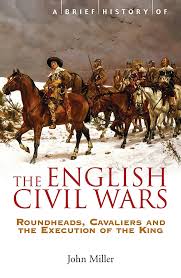
John Miller and the Burial of Revolution

John Miller’s A Brief History of the English Civil Wars is more than just a concise account of the 1640s; it embodies the revisionist orthodoxy that has shaped English Civil War history since the late 20th century. The defining feature of revisionist historiography… is its explicit rejection of the Marxist interpretation that the English Civil War constituted a bourgeois revolution.”

Miller’s work challenges not only Christopher Hill and the Marxist Historians’ Group but also the idea that history progresses through class struggle and revolutionary change.

Miller and the revisionist turn

The revisionist school, including Conrad Russell, John Morrill, Kevin Sharpe, and Miller, emerged specifically to challenge the Marxist claim that the English Civil War was a bourgeois revolution. Hill’s works, The English Revolution 1640 and The Century of Revolution, maintained that the conflict symbolised the political ascendancy of a rising bourgeoisie over a feudal-absolutist regime, paving the way for capitalist growth.

Revisionists challenged this framework by arguing that there is no measurable "rising bourgeoisie," as men from all social classes participated on both sides of the conflict. They claimed that religion and short-term political errors, rather than class struggle, fuelled the events. This perspective views the episode as a largely contingent, preventable tragedy resulting from Charles I’s political mistakes and brief religious divisions. In this view, Charles I’s execution is seen as an unfortunate accident rather than the decisive overthrow of a feudal system.

Miller’s book illustrates this change by providing a vivid narrative and personality-focused explanations instead of a deep analysis of social forces at work. It richly describes court intrigues, religious factionalism, and military campaigns, but it does not explore the core contradictions of a society shifting from feudal to capitalist structures. This approach is typical of the revisionist tendency to shift from structural analysis toward emphasising contingency and “high politics.”

Hill and the concept of bourgeois revolution

The Marxist interpretation by Hill and British Marxist historians never relied on a simple, mechanically deterministic model. Hill recognised that a “chemically pure revolution"—where all members of a class align perfectly—was unrealistic. As Ann Talbot notes, "Hill... had read enough Marx and Lenin to understand that one could not expect a chemically pure revolution." The focus is not on sociological neatness but on the revolution's actual function: it inherently advanced bourgeois interests by dismantling the feudal-absolutist state, executing the king, abolishing feudal tenures, and creating the political environment necessary for capitalist growth. Hill’s works—Intellectual Origins of the English Revolution, Economic Problems of the Church, and The Century of Revolution—connect ideological and religious conflicts to changes in property, commerce, and class dynamics.

What Miller’s approach obscures

Revisionism cannot account for why people at the time viewed the 1640s as a period of unprecedented upheaval. As censorship eased, groups like the Levellers, Diggers, Ranters, and Fifth Monarchists gained visibility in print, advocating demands that went beyond merely restoring an “ancient constitution”: "They called for levelling social classes, ending private property, and establishing the rule of the saints." These groups articulated, using religious language, the social tensions brought about by the collapse of feudal relations and the rise of new forms of property and authority. Hill’s research considered these voices as evidence of profound structural change, whereas revisionism tends to dismiss them as marginal, eccentric, or solely theological.

The political function of revisionism

Miller’s focus on narrative and personality shifts away from exploring why civil war became possible and, eventually, inevitable. This creates a depoliticised history marked by vivid descriptions but lacking causal explanation, contingency without necessity, and tragedy without revolutionary context. The rise of revisionism can be traced to the period after the USSR's dissolution and the ideological campaigns against Marxism: "The revisionist school gained ascendancy in the period following the dissolution of the USSR, when the bourgeoisie internationally sought to bury the concept of revolution itself.”

This is essential. Denying that the English Civil War was a bourgeois revolution is tantamount to denying that capitalism arose through revolutionary violence. If capitalism is seen as the outcome of slow, peaceful development, then viewing it as susceptible to overthrow via revolutionary struggle is dismissed from the start. Ann Talbot’s WSWS review of Hill clearly links this political viewpoint: “The prevailing academic orthodoxy is that there was no bourgeois revolution because there was no rising bourgeoisie and that people from all social classes can be found on either side of the struggle ... The whole unpleasant episode could have been avoided if only Charles II had been a little wiser.”

Contemporary significance

Many modern historians, like Simon Schama, often see themselves as "born-again Whigs,” offering a polished account of constitutional development and national cohesion. This view echoes the tradition that Hill aimed to challenge during his work. Instead of introducing a radically new perspective, revisionism mainly revisits earlier, pre-Marxist Whig interpretations of history, now presented with an air of empirical scepticism.

Today, whether the English Civil War was a bourgeois revolution remains a relevant issue for the working class. “A class that cannot face its own revolutionary origins cannot face the revolutionary future that awaits it." The bourgeoisie once celebrated its revolutionary history; now, its denial of that past shows its evolution into a fully counter-revolutionary class. To see the English Revolution as a true revolution—and to glean lessons for the fight against capitalism—is the role of Marxist history and a politically organised, conscious working class.

Miller’s A Brief History of the English Civil Wars, by aligning with revisionist orthodoxy, engages in the ideological act of masking that revolutionary legacy. In contrast, your critique aligns with the traditions of Hill and Trotsky, emphasising that the English Civil War was a pivotal event marking the shift from feudalism to capitalism, and that its significance can only be understood from the perspective of class struggle.

Bibliography

Primary and historiographical works

  • Christopher Hill, The English Revolution 1640 (London: Lawrence & Wishart, 1940).
  • Christopher Hill, The Century of Revolution 1603–1714 (London: Nelson, 1961).
  • Christopher Hill, Intellectual Origins of the English Revolution (Oxford: Clarendon Press, 1965).
  • Christopher Hill, Economic Problems of the Church in the Sixteenth Century (London: Oxford University Press, 1956).
  • Leon Trotsky, Where Is Britain Going? (London: New Park Publications, 1973; originally 1925).
  • John Miller, A Brief History of the English Civil Wars (London.
  • Conrad Russell, The Causes of the English Civil War (Oxford: Clarendon Press, 1990).
  • John Morrill, “The Religious Context of the English Civil War,” like the English Revolution, ed. Morrill (London: Longman, 1993).
  • Kevin Sharpe, The Personal Rule of Charles I (New Haven: Yale University Press, 1992).

On Marxist and revisionist historiography

  • Alastair MacLachlan, The Rise and Fall of Revolutionary England: An Essay in the Fabrication of Seventeenth‑Century History (New York: St. Martin’s Press, 1996).
  • Harvey J. Kaye, The British Marxist Historians (Cambridge: Polity Press, 1984).

WSWS and contemporary commentary

  • Ann Talbot, “Christopher Hill and the English Revolution,” World Socialist Web Site (WSWS).
  • Simon Schama, various works and interviews describing himself as a “born‑again Whig” in relation to English history.


Wednesday, 3 August 2011

Review of Michael Bennett’s The Civil Wars Experienced: A Marxist Reassessment

Michael Bennett’s The Civil Wars Experienced offers a clear and engaging overview of the English Civil War, aiming to expand the narrative beyond just Westminster and Whitehall. His focus on the lived experiences of ordinary people, along with his coverage of the Scottish and Irish theatres and emphasis on the conflict's brutality and social upheaval, reflects key aspects of the 1990s revisionist perspective. However, this strength is tempered by a notable limitation: Bennett almost uncritically accepts the revisionist view that rejects labelling the English Revolution as a bourgeois revolution. This interpretive stance is significant, as it represents one of the major historiographical debates of the past fifty years, with Bennett aligning with the camp that sees the revolution as a multinational crisis devoid of social content.

Bennett’s work, while full of narrative detail, is constrained by the revisionist framework he uses. Viewing the English Civil War as a revolution—one that shattered the feudal aristocracy’s political power and laid the groundwork for capitalism—requires a socio-economic analysis that Bennett neither attempts nor acknowledges. As a result, his book effectively describes the war but does not interpret it as a revolution.

The Revisionist Turn: Description Without Explanation

Bennett is part of a group—including Morrill, Stoyle, Lindley, and, earlier, Conrad Russell—that, in the 1990s, challenged the dominant Marxist and Whig views of the mid-20th century. Their aim was not just to refine previous “grand narratives" but to launch a political counter-attack against the very idea of the bourgeois revolution, as the critique suggests.

The revisionist method is familiar: collect empirical anomalies, emphasise local and contingent factors, highlight cross-class loyalties, interpret ideological innovation as religious eccentricity, and dismiss socio-economic causation as merely 'deterministic.' Bennett adheres to this method, noting that individuals from all social classes participated on both sides of the conflict and concluding that class struggle does not account for the war. However, this reflects a fundamental misunderstanding of the Marxist approach. “One does not expect a chemically pure revolution in which members of a single social class align on one side of the barricades and members of another on the opposite side.”

The goal is not merely to tally artisans or gentlemen on each side. Instead, it is to uncover the social forces that drove diverse people into conflict and to examine the new, revolutionary ideas that often appeared in the form of religious sectarianism—sometimes in a "curious and archaic guise." Despite its rich empirical detail, Bennett’s book focuses on describing the war rather than on exploring the causes of the revolution.

The “Three Kingdoms” Framework: A Useful Lens Turned Into an Evasion

Bennett’s key organising principle is the “Wars of the Three Kingdoms” framework. This approach is not inherently problematic, as understanding the English Revolution requires considering Scotland and Ireland. However, revisionists employ this framework not to enhance analysis but to avoid it. When used to soften or dismiss the revolutionary aspects of the events, this framework becomes a form of evasion.

Bennett’s account portrays the conflict as a national crisis involving governance, dynasties, and religious tensions throughout Britain. However, it overlooks the revolutionary break of 1649—the execution of Charles I, the abolition of the monarchy and the House of Lords, and the emergence of parliamentary sovereignty. These were truly revolutionary acts, not just constitutional errors. The choice of the term “Three Kingdoms” instead of "English Revolution” reflects a specific political stance, not neutrality. This perspective frames the revolution as a tragic event that could have been avoided “if only Charles I had been a little wiser," echoing Royalist sentiments in a modern academic tone.

Why the Bourgeois Revolution Framework Remains Indispensable

Bennett dismisses the notion that the English Civil War was a bourgeois revolution without offering arguments, as if the question were already settled. However, the framework of a bourgeois revolution remains crucial for several reasons. The defining feature of a bourgeois revolution is its outcome, not the purity of class struggles: it involves the dismantling of feudal political systems, the establishment of parliamentary dominance, the rise of ideas like natural rights and contract theory, and the paving of the way for capitalism. The execution of Charles I was not merely a misunderstanding among kingdoms; it marked a fundamental break from feudal traditions. “No monarch sat easily on the throne after that event, emphasising its revolutionary significance.

The Revisionists Reject Causation Itself

The revisionists’ main argument—that there was no growing bourgeoisie and thus no bourgeois revolution—is historically unsustainable. In early seventeenth-century England, there was significant economic change: expansion of commercial agriculture, London’s rise as a financial hub, greater involvement in global trade, and the rise of a politically active gentry and merchant class. Ignoring these changes overlooks the very factors that enabled the revolution.

The Levellers, Diggers, and sectarian radicals were not just religious eccentrics; they also promoted new ideas about sovereignty, natural rights, and political equality. These notions were revolutionary, even when conveyed through biblical language. Bennett recognises their existence but struggles to explain how these ideas arose.

Hill’s Achievement—and the Task That Remains

Christopher Hill’s achievement was twofold: he identified the mid-seventeenth-century crisis as a revolution that overthrew one class and brought another to power. He recognised that the masses drive revolutions and require a change in consciousness. Bennett’s work implicitly challenges both ideas. However, Hill also had his limitations; he never fully contextualised the English Revolution within its broader international setting.

A comprehensive Marxist analysis should incorporate the wider European context, including the Thirty Years' War, Dutch republicanism, continental natural rights theory, and the decline of feudalism across Europe. In contrast, the revisionists, by restricting their focus to three kingdoms, distance themselves further from this broader international perspective.

Bennett’s Strengths and the Marxist Counter‑Case

Bennett’s The Civil Wars Experienced provides a clear, accessible, and often vivid overview of the conflict. It works well as a narrative history and offers insight into the human experience of war. However, its analysis is limited by its revisionist approach, which dismisses socio-economic causes, interprets revolutionary upheaval as merely a dynastic crisis, and considers ideological change as religious eccentricity.

Sources and Bibliography

Primary Sources

  • Burton, Thomas. Parliamentary Diary. London: 1828.
  • Clarendon, Edward Hyde. The History of the Rebellion and Civil Wars in England. Oxford: 1702–1704. (Clarendon’s analysis of political divisions is cited in JSTOR’s discussion of Marx and Engels’ interpretation of the Civil War .)
  • Hobbes, Thomas. English Works. London: 1839–45. (Hobbes’ remarks on the social power of the Presbyterians are referenced in the JSTOR article .)
  • Harrington, James. The Commonwealth of Oceana. London: 1656. (Harrington’s class analysis is discussed in the JSTOR article .)

Marxist Historiography

  • Carr, E.H. What Is History? London: Penguin, 1961.
  • Engels, Friedrich. The Peasant War in Germany. 1850.
  • Hill, Christopher. The Century of Revolution, 1603–1714. London: Nelson, 1961.
  • Hill, Christopher. Intellectual Origins of the English Revolution. Oxford: Clarendon Press, 1965. (Hill’s method and influence are discussed in Elearn College’s article on Marxist historians .)
  • Hill, Christopher. The World Turned Upside Down: Radical Ideas During the English Revolution. London: Penguin, 1972. Hill’s focus on radical movements is discussed in the 2026 article on his historiographical impact
  • Hill, Christopher. Economic Problems of the Church. Oxford: Clarendon Press, 1956. (Referenced in Elearn College’s discussion of Hill’s economic analysis .)
  • Hilton, Rodney. Bond Men Made Free: Medieval Peasant Movements and the English Rising of 1381. London: Temple Smith, 1973.
  • Hobsbawm, Eric. The Age of Revolution, 1789–1848. London: Weidenfeld & Nicolson, 1962.
  • Thompson, E.P. The Making of the English Working Class. London: Gollancz, 1963.

Revisionist Historiography

  • Bennett, Michael. The Civil Wars Experienced. London: Routledge, 2000.
  • Morrill, John. The Nature of the English Revolution. London: Longman, 1993.
  • Russell, Conrad. The Causes of the English Civil War. Oxford: Clarendon Press, 1990.
  • Russell, Conrad. Parliamentary History in the 17th Century. Various essays.
  • Stoyle, Mark. Soldiers and Strangers: An Ethnic History of the English Civil War. New Haven: Yale University Press, 2005.
  • Lindley, Keith. The English Civil War and Revolution: A Sourcebook. London: Routledge, 1998.

Three Kingdoms / British Context

  • Canny, Nicholas. Making Ireland British, 1580–1650. Oxford: Oxford University Press, 2001.
  • Cust, Richard, and Hughes, Ann (eds.). The English Civil War. London: Arnold, 1997.
  • Ó Siochrú, Micheál. God’s Executioner: Oliver Cromwell and the Conquest of Ireland. London: Faber & Faber, 2008.
  • Stevenson, David. The Scottish Revolution, 1637–1644. London: David & Charles, 1973.

International and Continental Context

  • Asch, Ronald G. The Thirty Years’ War: Europe’s Tragedy. London: Allen Lane, 2010.
  • Israel, Jonathan. The Dutch Republic: Its Rise, Greatness, and Fall, 1477–1806. Oxford: Oxford University Press, 1995.
  • Skinner, Quentin. The Foundations of Modern Political Thought. Cambridge: Cambridge University Press, 1978.
  • Trevor-Roper, Hugh. Religion, the Reformation, and Social Change. London: Macmillan, 1967.

Modern Marxist Commentary

  • Talbot, Ann. “Christopher Hill and the English Revolution.” World Socialist Web Site, 2003.
  • North, David. The Russian Revolution and the Unfinished Twentieth Century. Mehring Books, 2014.
  • Walsh, Chris. Various articles on revisionism and bourgeois revolution, WSWS.

Articles Identified in Search Results

  • “The English Civil War Interpreted by Marx and Engels.” JSTOR. (Contains discussion of Harrington, Hobbes, Clarendon, and class analysis in contemporary sources. )
  • “Marxist Historians and English Civil War.” Elearn College, 2025. (Discusses Hill’s intellectual legacy and Marxist historiography. )
  • “How Christopher Hill Turned History Upside Down by Studying the Radicals of the English Civil War.” 2026. (Provides biographical and historiographical context for Hill’s work. )